Category: Space Holding

  • UK leads new inner space race

    UK leads new inner space race

      Space
    Space

    But there are not nearly enough healers to dish out the (desperately required) medicine. Why?

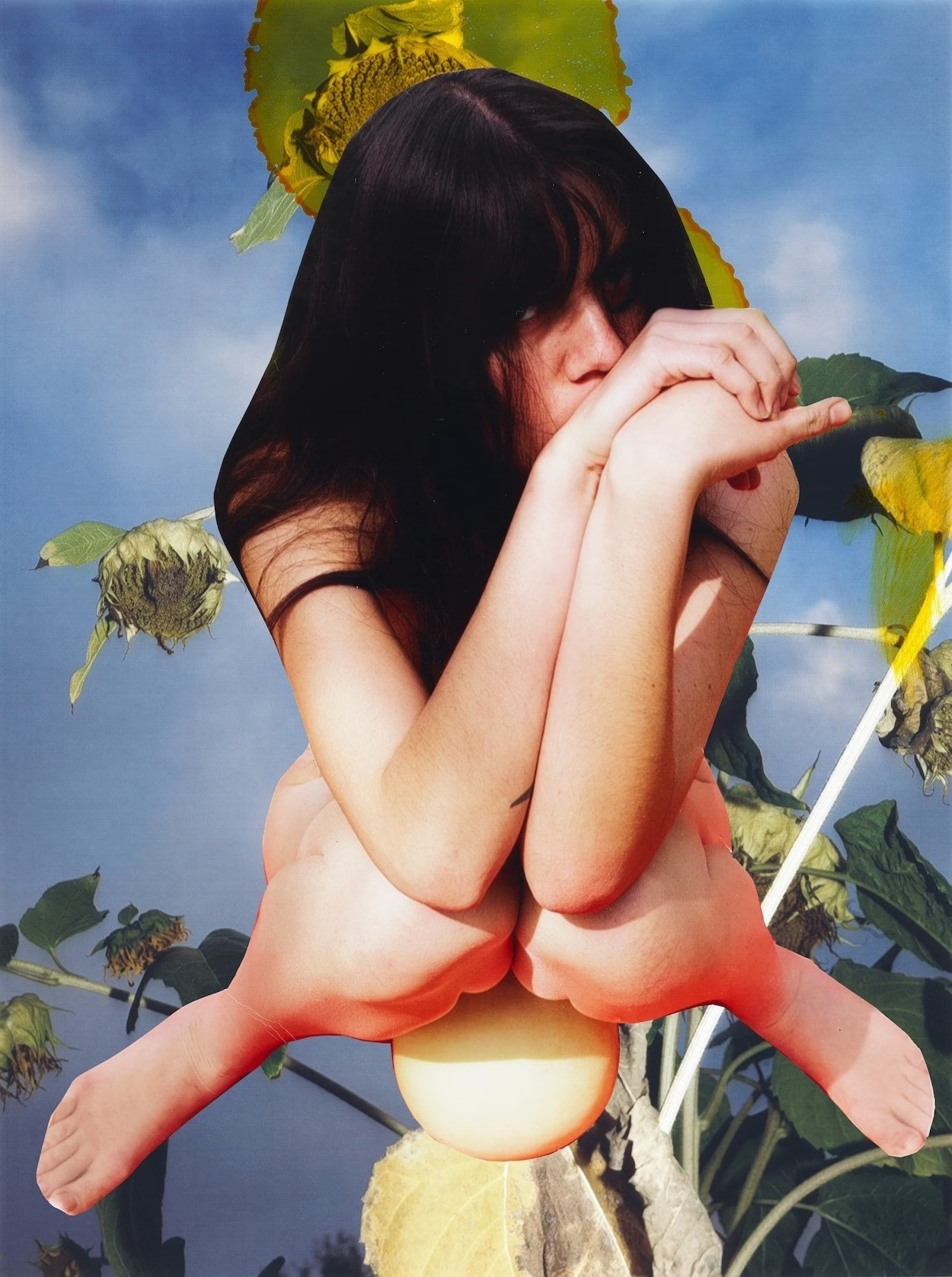
       This is actually from new ‘psychedelic amazement park’ Wake the Tiger  in Bristol
    This is actually from new ‘psychedelic amazement park’ Wake the Tiger in Bristol

    “Mental health workforces are shrinking at a time the demand for mental health services is increasing,” says the news blog for Europe’s first psychedelic research centre Clerkenwell Health, just down the road from me in London. 

    Dr Derek Tracy, medical director at West London NHS Trust, told Sky News earlier this month that he has never seen such a high demand for access to mental health treatment. “It’s as busy as I’ve ever seen in my career. Numbers are up across all age groups and in all types of presentations, in London and nationally.”

    March 2021 figures claimed a quarter of adults reported ‘clinically significant psychological distress’ that month, up from just over a fifth before the C-19 pandemic. 

    So one in four of us are suffering from… ‘clinically significant psychological distress’. Suicides are up again since 2018. In May 2022 the number of under-18s referred to emergency mental health services went up 37% on the previous year, a record high. Depression and anxiety are the number one reason for taking time off work.

    “There are not enough therapists to deliver these treatments”

    This while corks pop on bottles of Nyetimber as the UK is declared “world leading” in the innovative treatment research field.

    Back on Clerkenwell Health’s blog, “Developing new drugs has attracted significant commercial interest. But the delivery aspects of these treatments are yet to receive the same attention. There are more than 150 psychedelic drug developers in the market. Patients’ demand for psychedelics is also increasing.”

    Clerkenwell Health’s stark conclusion? “There are not enough therapists to deliver these treatments.”

    I’d respond: that’s because there are too many barriers to becoming qualified.

    This week Vital students heard from lawyer Courtney Barnes, who detailled Oregon’s facilitator license training requirement that are not dissimilar to its own syllabus. Clerkenwell Health’s own psychedelic therapy program requires accredited health professional (AHP) status for entry. Which puts it beyond my means, for example. That requires a degree in occupational therapy at least, or better still being a clinical psychologist, which involves a decade or so of grind that I’ve been told by those who know for sure is not worth me trying in my mid-40s. Psychotherapist training is three to six years according to the UK Council for Psychotherapy

    I wonder how long the list would really be of qualified individuals, who have experience with psychedelics, and have long harboured a compulsion towards a very different psychological approach? How do they feel about the commute to central London?

    Who otherwise has the time or the money to retrain? I’ve worked with graduates in £80K of debt who want to be superstar fashion stylists, not spend their days under fluorescent light talking to long-term alcoholics about their visuals. Experts from Stanislav Grof to Dr Rick Strassman implore upon prospects how demanding psychedelic therapy can be.

    This is before we talk about the 28% of AHPs who quit due to burnout, the 16% who want to leave the sector entirely, the 43% actively looking for a new job, or the third who cite low pay and overwork as the main issues.

    “Developing new drugs has attracted significant commercial interest. But the delivery aspects of these treatments are yet to receive the same attention”

    100,000 vacancies in the NHS lie unfilled while expensive and life-consuming qualifications that were once unnecessary – my mother worked as a midwife, and the ward sister at Dick Whittington Hospital A&E here in London with no university education – stand right in the way of anyone compelled to join the sector. Anecdotally: a friend who’s worked at a high level in nursing for 12 years, including on the COVID-19 ward, has to undertake an MSc (in… nursing) before she can go up a pay grade and become a senior nurse. Granted there may be one or two useful things she picks up during it, but compared to 12 years on the job will it be worth the time and the debt? Especially given the demand for senior nurses?

    Full psychopomp status via the Clerkenwell Health program lasts only three months and is free, incidentally. To accredited healthcare professionals.

    Embers of hope burn, certainly with outspoken, heritage foundations like Beckley emerging into the C-suite conversation and the fast-tracking of the MAPS PTSD programme. Though no wonder unofficial psychedelic mental health services thrive. While these may cater well to the slightly-unhealthy normals, who Grof to David Nutt say can benefit immediately from psychedelic experience alone, they cannot expect to hold back the tide of trauma and addiction. And as almost everyone connected to the issues –except the gatekeepers – agrees, the current set-up certainly can’t either.

  • Complex cosmologies, explained

    Complex cosmologies, explained

      Space
    Space

    Syrupy new age spirituality cannot hope to illustrate our lived experience. What can?

        From      Modern Alchemy      published by JBE Books
    From Modern Alchemy published by JBE Books

    ‘Psychedelic rhetoric’ is a term I’ve been searching for.

    I can’t claim to have coined the phrase or for it to be sacred ceremonial insight.

    Instead it is the words of academic hotshot Reanne Crane, a linguistics expert at the ever-more radical University of Kent. She spoke at The University of Exeter’s Philosophy of Psychedelics Conference 2022. On the programme, one of the keywords listed for her talk was ‘synthesisers’.

    “Everything’s ineffable. If I had to describe the experience of sitting on this chair I’d have trouble”

    Music’s only one method we use to communicate notions language – especially this one – can’t. Words certainly don’t do justice to the psychedelic experience, as we are all painfully aware. In her talk Scrap the Book: Polymodes, Metaphors, and the Psychedelic Skyline at The University of Exeter’s Philosophy of Psychedelics Conference 2022 Crane asked, what damage might that be causing and what can we do to make it better?

    Crane, also a bedroom producer and songwriter, used ‘cleaning the filter’ as an example of witless psychediatribe, employing contemporary sound design to demonstrate her point. 

    Making a rockstar late entrance, Crane strode down the auditorium steps and took straight to the stage declaring, “Everything’s ‘ineffable’. If I had to describe the experience of sitting on this chair I’d have trouble.”

    Lumbering late Anglo-Saxon lingo requires myth and story to weave in philosophy and perception. “Indigenous people don’t need to say ‘ineffable’ because they have complex cosmologies,” Crane delivered in her plain-speaking Yorkshire accent. “Losing our grip on absolute truth might be what we all actually need right now,” she declared to a hall of hardcore truth seekers while hovering cross-legged above a conference chair.

    Awareness of other realities is the key to coming to terms with our own, say the modern-day explorers returning from in-depth field research.

    “If we remove the mushroom from our taboos it loses meaning. And efficacy”

    Back at Vital where we’re drilling down on meta-awareness with a no-holds barred lecture on the realities of Amazonian shaman-hood.

    “Poetry can include nuance and euphemisms avoiding difficult subjects,” says Nicholas Spiers, a courageous anthropologist and film maker who directed space smash hit The Peyote Files and is Chacruna’s research coordinator.

    Nonetheless “Difficult questions are not answered by the new age” says Spiers to rapturous applause from this website. The West has been ‘addicted’ to positivist spirituality for decades. Our crystal-based codswallop is a sanitisation of the post-industrial Western mysticism inspired by Helena ‘Madam’ Blavatsky in the 1800s. Can we cope with the lessons of the plants?

    Because this particular medicine might be difficult to swallow. “Objects with particular material value are considered profane,” expands Spiers, “neither does anybody ‘own’ the trees, or the forests.” To put it another way: Chihones, morally ambivalent spirits of nature, can infect you with illness for not respecting natural customs. Does that somehow strike more of a chord?

    “It’s OK to use the mushroom to find a missing rooster”

    It gets worse: “If we remove the mushroom from our taboos,” as we do seem set on doing to some extent, “it loses meaning… and therefore efficacy,” warns Spiers.

    Human ingenuity and good old acceptance can see us though. During his time with the Maztecha, Spiers was taken by one way the gentlemen of the village compete in their craft. “They use permaculture farming styles to grow organic coffee using natural predators to kill pests. The ferocity of the wasps’ nest on your farm is highly valued.”

    It’s not all “cosmic diplomacy” with the Chihones and working alongside wasps amongst the indigenous though. Spiers points out there are other advantages besides a resolution with nature: “It is seen as appropriate to use the mushroom to do practical things. Like, find a missing rooster.”

  • Holy vape pens, Metatron!

    Holy vape pens, Metatron!

      Space
    Space

    Arguing where DMT entities come from is moot says Dr Strassman. Besides, they’re angels

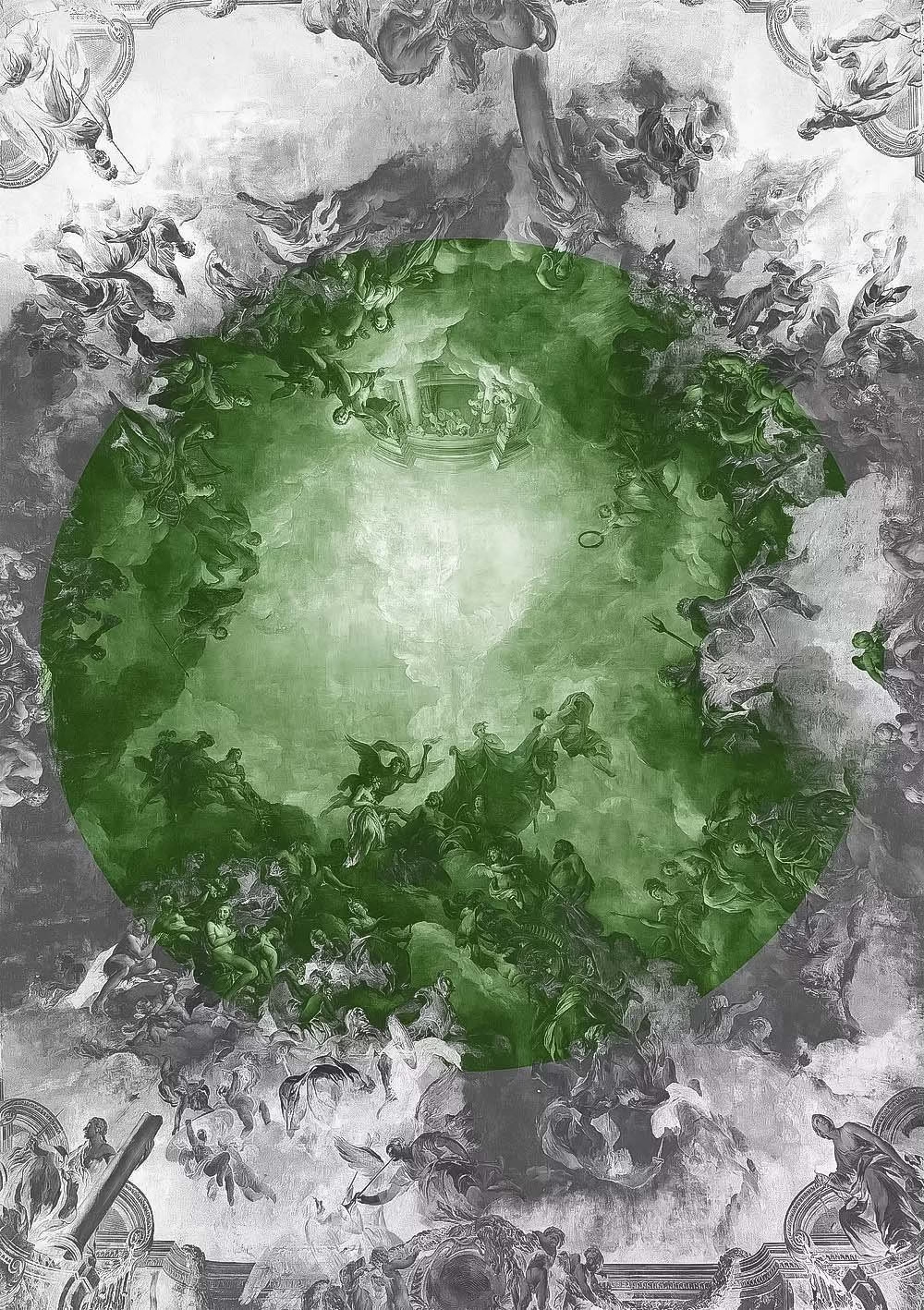
       Magnus Gjoen, ‘I Saw the Sky Come Down to Meet You’ available      here     .
    Magnus Gjoen, ‘I Saw the Sky Come Down to Meet You’ available here .

    It’s how and what we learn from DM entities that counts. Not their origin, says Dr Strassman.

    “The most important thing is how we use our words. Can we ask the right questions? Can we ask the right answers? And remember them?” says the Spirit Molecule author.

    Dr Strassman might be wary of bringing established religions into psychedelic therapy. But he’s certainly not against using them to aid discovery. “The established model is ‘neurotheology’ which states the brain is at the centre of human experience. Things can get it off that: drugs, fasting sleep deprivation, that trigger brain reflex changes. But these are described after the fact as ‘spiritual’ and given terms like ‘openness’, ‘ecstasy’, ‘out of body experience.’ 

    Modern science, which is informed by the biological, competitive model put forward by Sigmund Freud and Richard Dawkins, explains this as “We’re evolutionarily configured to be perceptive, compassionate, empathic and sociable to help us survive.”

    This explanation might be tight, but fails to include the grander narrative that DMT is especially at pains to impress upon us is ‘real’, or ‘noetic’ to the scientific language. “During the 1990s tests, I learned that I wouldn’t get the same debriefs out of subjects unless I took their DMT experiences to be real,” says Strassman on his YouTube. And can we just explain away art, love, friendship, purpose and so many other wonderful things, as stuff we do to get laid?

    “I expected Zen shunyata without form, feeling, consciousness, perception or volition… empty. It turned out DMT was everything but”

    Theoneurology, outlined in Strassman’s book DMT and the Soul of Prophecy: A New Science of Spiritual Revelation in the Hebrew Bible flips the script, proposing the ‘divine’ whatever it might be, informs neurology. This could be said to suit the psychology of Carl Jung.

    At this point it’s worth noting that the two Vital lecturers who’ve cautioned the most against ‘transcendence porn’ and the quest for a ‘mystical experience’, Bill Richards and Strassman, are both deeply religious individuals. 

    “Buddhism saved my life after I dropped out of medical school,” Strassman says, “I became a serious practitioner for two decades. I’m in its debt. It was the closest thing I had come across that strengthened the psychedelic experience, and also strengthened my belief there was some intimate relationship between psychedelic states and buddhist practice.”

    When he began his famous early 1990s DMT tests he expected the experiences to mirror buddhist teaching: “Both myself and the subjects expected something similar to Tensho, the Zen state of shinyata, “without form, feeling, consciousness, perception or volition… empty.”

    However, “It turned out that DMT was everything but that.”

    He continues: “The beings, the visions, the information… The personality was maintained, even strengthened. There was space and time, it was distorted but it still existed. This was not consistent with my data.” Strassman was subjected to an ego death of sorts: “I had to go back to the drawing board.” (Dr Strassman’s N, N-Dimethyltryptamine DMT is not to be confused with 5-MEO DMT of Sandoran desert toad fame, which is said to produce a ‘white out’ experience.)

    Other influences were at play in this ontological snafu. “I was being discouraged by the American buddhist organisation, for being too truth-orientated. I ended up studying judaism and being impressed by prophecy.” Ever the scientist, he uses ‘impressed’ to mean ‘could be useful’.

    “Armed with an expanded definition of prophecy from Maimonides, I began to compare the visions from the Old Testament and DMT”

    At the 2015 Tyringham Initiative gathering, Strassman stunned even the world-class psychedelic thinkers in attendance by delivering a bravura presentation on how Old Testament dialogue can be employed when chatting to DMT ‘entities’. (Read about it in the superlative DMT Dialogues book covering the whole conference, edited by Dr David Luke). Correspondence in hyperspace is notoriously difficult, and can include important elements like divulging the intentions of the entity in question, or decoding the information they relay.

    To clarify, “Prophecy doesn’t always mean foretelling like the canonical prophets do. It includes any spiritual experience: from the nameless soldier who has a dream predicting victory for Israel to Moses on mount Sinai.” The key text to study apparently is The Guide of the Perplexed, written by the Ottoman Emperor Saladin’s physician and astronomer Maimonides’ in 1190. 

    “Maimonides borrowed Aristotle’s concept of ‘active intellect’ conflating information from the past, present and possible future,” says Strassman in this interview with a Hebrew mystic channel.

    According to Maimonides’ own introduction, “The Guide of the Perplexed has a second object: it seeks to explain certain obscure figures which occur in the Prophets. Even well-informed persons are bewildered if they understand these passages in their literal signification. But they are entirely relieved of their perplexity when we explain, or merely suggest that the terms are figurative.”

    In recent podcast interviews Dr Strassman’s been keen to insist he’s presenting the notion as “an interested theologian” rather than a profile scientist. It doesn’t stop him bringing in medical anecdotes, like left-brain stroke victims seeing in ‘pixelated’ vision. Anyway, back to the Bible. 

    “Armed with an expanded definition of prophecy from Maimonides, I began to compare the visions from the Old Testament and DMT. And, descriptively phenomenologically, the visions, the voices, the emotions, the effects on the body… were quite similar.”

    You may’ve figured that we’re getting into the ‘advanced class’ of psychedelic use here. So I’ll end with this passage from the book of Ezekiel, a favourite with contemporary churches, abridged by Strassman in his 2015 Tyringham Initiative presentation.

    “Ezekiel’s messages came from God and were intended to be given to the wider community. In chapter one, the heavens open, there’s a stormy wind, brilliant light, beings emerge from the fire. There are spheres, wheels. Ezekiel sees faces of beings: a man, a lion, an ox, an eagle. The beings run rapidly to-and-fro despite the immobility of their legs. Their backs and wings are full of eyes. Some beings fly through space. Thee is an expanse of blue, or a rainbow, above their heads. Ezekiel loses all strength, falls on his face. An angel stands him up, speaks to him, pulls him by the hair, and carries him through space.”

  • Who knows what lurks in the hearts of men and women?

    Who knows what lurks in the hearts of men and women?

      Space
    Space

    The shadow, obvs. And it has unfinished business… with you

      By    Rashed Al Shashai
    By Rashed Al Shashai

    A significant event like taking a step forward in human consciousness has got to involve some kind of challenge, like a hero’s journey, right?

    “We will have to bear the tensions of the opposites. There are no easy ways forward. We will have to grapple with the unknown,” said the magnificent Maria Papaspyrou, editor of The Psychedelic Divine Feminine and founder of Brighton’s Institute of Psychedelic Therapy, at July 2022’s Breaking Convention conference.

    Paradigm shifts in society though begin at home, with our own ‘shadow work’.

    The Jungian negotiation process with complex urges that we feel from sheepish to psychotic about, is crossing over fast. The subculture is throwing out stardust like London’s Kemetic shadow witches High Priestxss.

    “The greatest sense of agency and healing is often found at the centre of the storm”

    And start-up bros are said to be seeking a fresh challenge that even sounds like the psychedelic version of an iron man triathlon.

    “Serenity, salvation and strength are not always found in the upward sense to the light,” commented a richly experienced trauma specialist in my Vital study group, Kelli Ann Dumas, “they spring from inward: deep, in the ripeness of the trauma. The darkest part of the night is just before dawn. The greatest sense of agency and healing is often found at the edge of the depth, at the centre of the storm.”

    Crucially insiders say shadow work is mandatory for psychedelic therapists and guides, to clear any lingering sense of grey areas from the set and setting for example, and to engage in a regular process of checking one’s motivations: “The more clearly you understand yourself and your emotions, the more you become a lover of what is,” wrote philosopher Baruch Spinoza.

    Dr Sjöstedt-Hughes’ psychedelic philosophy, explained in his lecture to Vital students, takes shadow work a step further. It challenges our status quo that inherently considers stability and comfort to be desirable; the ‘slave morality’ of Nietzsche.

    Over to another of Sjöstedt-Hughes’ worldly philosophers, Ernst Junger:

    “I am an anarch in space, a meta-historian in time. Hence I am committed to neither the political present nor tradition; I am blank and also open and potent in any direction. Dear old Dad, in contrast, still pours his wine into the same decaying old wineskins, he still believes in a constitution when nothing and no one constitutes anything.”

    Sjöstedt-Hughes has poured over Whitehead’s personal copy of The Will to Power written by Nietzsche in 1887-8.

    “There are no easy ways forward”

    He points out Whitehead has double-underlined the line, ‘The contempt and hatred of all that perishes, changes, and varies: whence comes this valuation of stability?’

    Whitehead also finds Nietzsche pondering inter-connectedness, another psychedelic philosophy staple. He also gets his luminous marker out for, ‘It is essential that one should not mistake the part that ‘consciousness’ plays: it is our relation to the outer world; it was the outer world that developed it.’ Sjöstedt-Hughes draws further parallels between the will to power and Alfred North-Whitehead’s examination of consciousness providing our sense of purpose.

    “I am an anarch in space… a meta-historian in time”

    Repressed by the slave morality, we are mostly forbidden to sate the instincts that torture us unheeded. Honing our arete, the ancient Greek term for a sense of purpose that they aspired to instead of ‘happiness’ contemporary Western society considers irresponsible and selfish.

    It certainly does not encourage or revere our cyclical development like the ancient Egyptians. Let alone steaming around openly admitting “I am no man. I am dynamite,” like Nietzsche.

    Terrence McKenna considered ‘lived experience’ to be the ultimate form of spirituality. The path to virtu, notoriously, involves actions we find daunting yet fulfilling.

    Although hedonists will be pleased to know arete and the will to power don’t need to involve soul-shattering grail quests, or crossing the abyss, all the time… or not at least.

    Ask Ernst Junger. He might have decreed, “What doesn’t kill me makes me stronger; and what kills me makes me incredibly strong,” but he also swore by:

    “The Epicurean is the master of pleasure and knows how to moderate it, not so much from subjection to discipline as from the love of pleasure itself.”

    Always Dionysus – never the crucified.

  • Strength of street knowledge

    Strength of street knowledge

      Space
    Space

    What can the medical sector learn from the space? “Everything,” says Dr Luke

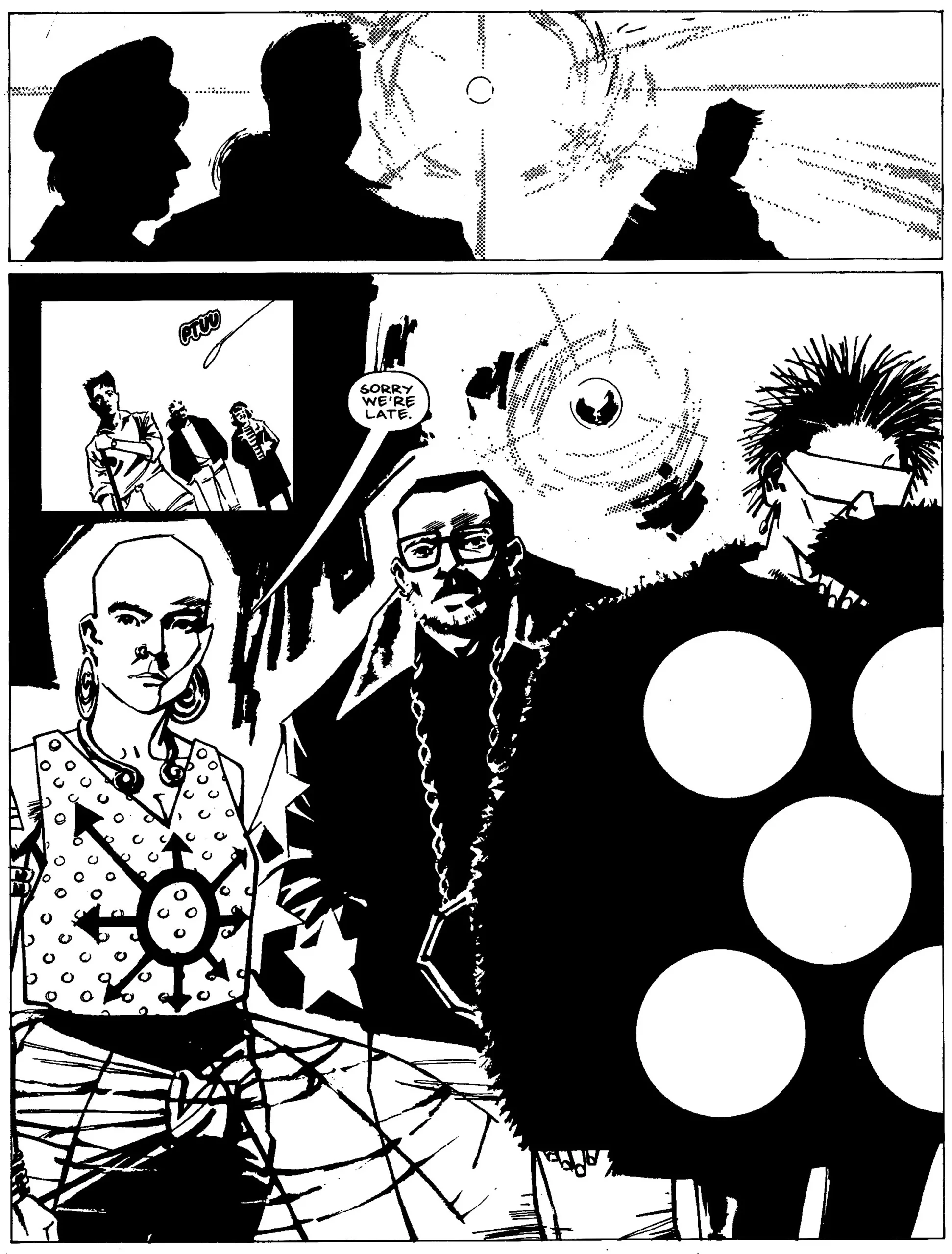
       If you like this there’s another    Grant Morrison    reference in the issue
    If you like this there’s another Grant Morrison reference in the issue

    ‘Field research’ is Dr Luke’s term for the surveys and private research projects he’s conducted on the fringes of everyday reality.

    “It’s citizen science at its finest – but tragically illegal,” expanded Dr Luke in answer to my question, ‘What can the medical sector learn from the psychedelic subculture?’

    “I’ve invented ‘psychograms’ to represent all sorts of altered states,” he offers by way of an example, “I have about four art-stroke-science virtual reality projects on the go right now ranging from inducing synaesthesic meditation to interplanetary inter-connectedness and the tarot,” he says. “It’s the inverse – you alter your perception to change your brain, rather than alter your brain to change your perception. We have things like that at the festivals, they supposedly replicate the effects psychedelics… at least on paper according to the tests. I slightly don’t believe it, but there is massive potential.”

    While keen to stress that “psychedelics are not a panacea” like all authentic experts, extensive surveys conducted by Dr Luke and his team “show that they can be good for all kinds of things actually, from autism to Parkinson’s.”

    “This is the intersection of science, and genuine transcendence of time/space to bring back information”

    In the suburban living rooms of Britain something stirs. “We go round to people’s houses, it’s much more pleasant for the subjects. We did some experiments with precognitive individuals, and put shared experiences declared by ayahuasca users under the microscope: two people, experienced users who didn’t know each other, weren’t allowed to talk beforehand, attempted to join each other in the experience, and were interviewed separately afterwards. I haven’t fully evaluated the data as independent judges are interpreting the reports and images. But just eyeballing the material, I thought it was a long shot but… it looks like we’re going to get something quite significant. Albert Hoffman saw the doctor coming with an obsidian knife and feathered headdress. He knew where the provenance; his colleagues in Basle had similar visions, but no idea of any connection to Mexico or the Inca.”

    This is the intersection of science, “and genuine transcendence of time and space to bring back information,” declares Dr Luke, “I’ve been looking into creative problem solving with scientists in DMT, bridging the gap between shamanism and science. It speaks to the very nature of reality, the meeting point between world views. And nobody’s asking these questions. They’re asking ‘What does it do in the brain?’ questions. And they’re getting ‘What it does in the brain’ kind of answers. They don’t engage with the glaring ontological questions about the nature of reality.”

    He believes the obvious experts to ask, like many actually do, are the DMT explorers of the Amazon. “Collectively as a culture they have thousands of years of expertise,” Dr Luke says, “They were the original keeps of the wisdom and the substances. They haven’t been invited to the table at these multi billion dollar conferences.”

  • Cosmic Midwifery

    Cosmic Midwifery

      Space
    Space

    Psychedelic therapy sets the stage for new life to flourish

       Leonora Carrington,    ‘The Temple of the Word’
    Leonora Carrington, ‘The Temple of the Word’

    The psychedelic therapist offers presence, but doesn’t require reporting on behalf of the client. “At a very high dose, we are beyond words anyway,” advises Dr Richards.

    Guides are “like midwives, they create a container” to encourage the voyager’s “own choreography of the experience.”

    Voyagers should be prepped to “dive into the pupil of the monster” lest one pounce from the shadows of their psyche. Challenging experiences are actually quite unusual (only 40% of users say they’ve had ever one) but “we all have our cross to bear – our trauma” reminds Dr Richards.

    “We are primarily dealing with human consciousness,” says the Maryland and Spring Grove veteran, “a meaningful process unfolding from within.” He says objects to examine and inspire, personal or otherwise, can be offered to the voyager who appears inquisitive.

    “We are primarily dealing with human consciousness”

    Guides practising in legally permitted conditions from my study group say music is a fine changer of mood, especially with those who may have difficulty expressing their mystical sides. These “external routes to mystical consciousness” as Dr Richards dubs them, like the rose bud of lost era lore, or family photos used by silver age guides, can ‘make the energy dance’ like Alfred North Whitehead suggested. Suddenly everything is important, but somehow irrelevant, and both are absolutely fine. Unless they’re not.

    “Philosophy is the self-correction by consciousness of its own initial excess of subjectivity,” wrote Whitehead in Process and Reality: An Essay on Cosmology, “[it] may not neglect the multifariousness of the world — the fairies dance, and Christ is nailed to the cross.“ Quite.

  • Can you hold your own?

    Can you hold your own?

      Space
    Space

    In psychedelic therapy as any other, you have to take responsibility for your own mental health

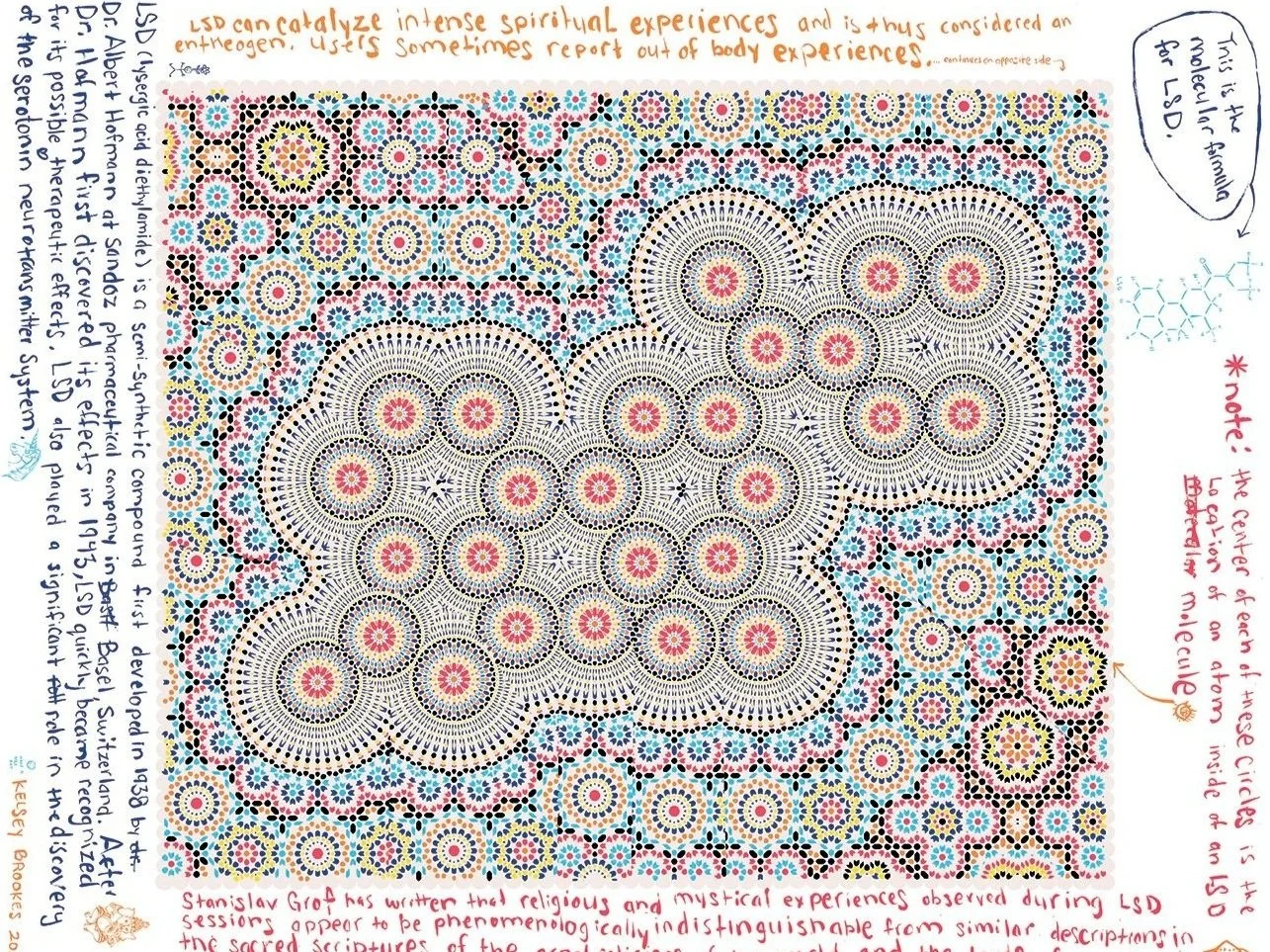
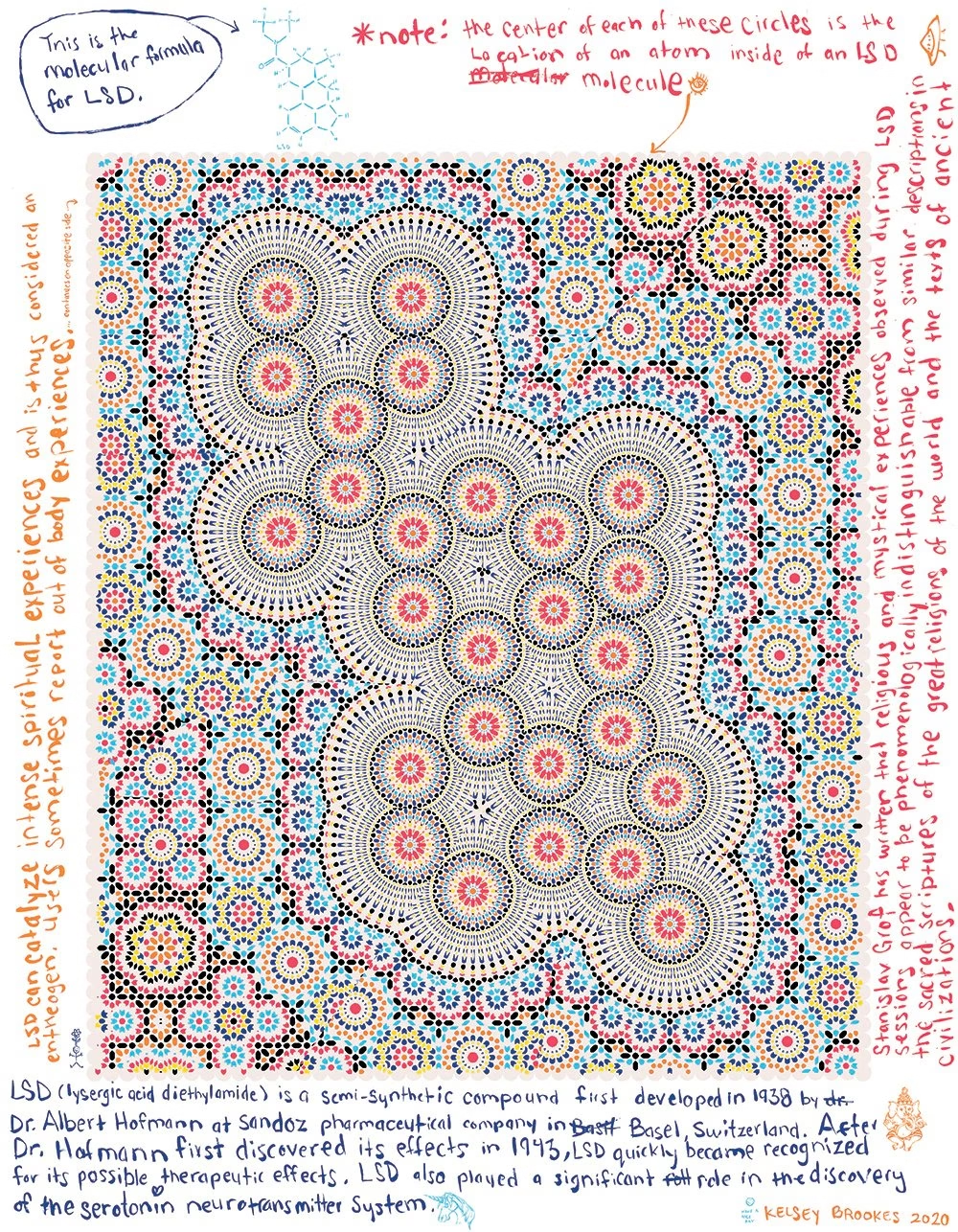
      Kelsey Brookes, LSD Poster,    available here
    Kelsey Brookes, LSD Poster, available here

    The Imperial College testing rooms are the most British thing I’ve ever seen.

    There’s a blanket thrown over the studio kitchen in the corner, a drape with some trees on and a lamp stuck behind it, plus some spiritual tat.

    It does look surprisingly cosy nonetheless, especially with Dr Ros beaming angelically from her seat in the corner. But you almost certainly have to dream the Albion way to appreciate its understated succour. Bar the open heartedness oozing from the ever-radiant Dr Ros, being served the Mysteries by the priestesses of Demeter it is not. Neither is donning a blindfold plus headphones, and boasting a grin like the one that betrays the fact you don’t normally fly business class, an experience surely at all comparable to the jungle ayahuasca one.

    12-step style integration and ceremony – my bad, ‘celebrating the mysteries’ – circles were mentioned as future possibilities by Psych delegates in a huddle with Imperial College trials participants Iain Roullier and Leonie Schneider, unsung heroes of the UK space who also spoke onstage with Dr Ros repping their PsyPan set-up. In the meantime there is… an app.

    “The substance is only 51% of the process”

    ‘Holding space’ doesn’t seem to have been much of an issue during contemporary scientific tests and education regarding bad trips-stroke-challenging, purgatorial experiences may take the edge off them so to speak. Admittedly a guide, let alone a skilled psychotherapist or shaman, may be good for a bad trip too. Because surely MindMed’s ‘off switch’ jab is cheating*.

    An old pal has just reminded me that our sitter was a table leg with an acid house smiley face drawn on it which we kept in the back of the van. The Wild Hunt rides.

    *Take the off switch if they offer it or at least don’t say I told you not to