My unofficial Vital Study Zine #17 with observations from Vital Psychedelic Training and recent happenings in the space
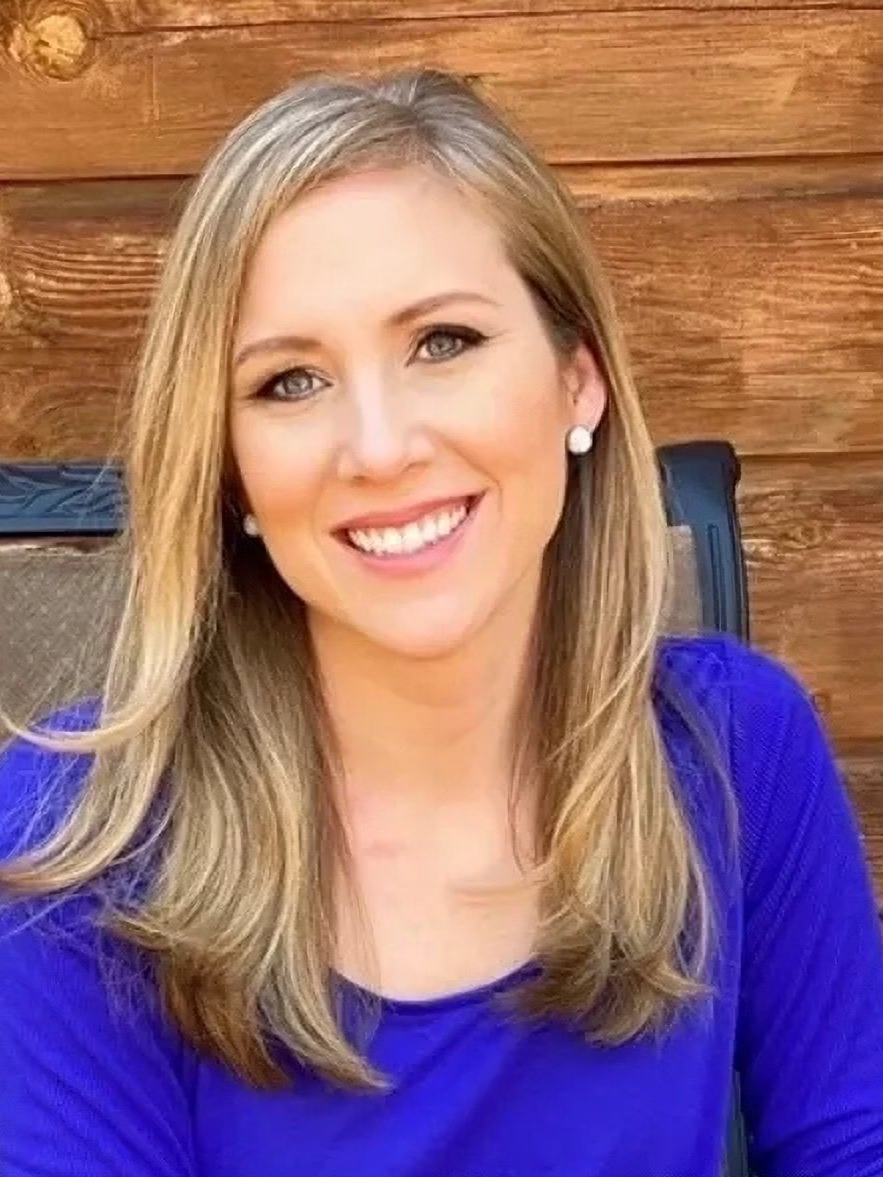
“I want to be a steward for reality,” declares clinical psychologist Dr Adele La France.
The effervescent Dr La France is famously ‘based’.
She cracks off her talk to Vital students about the practicalities – the reality if you will – of psychedelic therapy by explaining how she was generally anti-psychedelic drugs, until she experienced them in a medical context.
Her clinician’s manner is a masterclass in marrying authority, whimsy and vision. She’s the co-creator of Emotion Focussed Family Therapy; her clinical manual on it is published by the notoriously hard-to-please American Psychological Association. Dr Lafrance’s new book What to Say to Kids When Nothing Seems to Work: A Practical Guide for Parents and Caregivers is out now at a family-friendly price.
While toiling at the sharp end of mental health, she’s spoken convincingly (and warmly) about topical issues like taking ayahuasca to heal eating disorders on Emmy Award-winning daytime TV show The Doctors, and video game addiction on CBS. She’s currently working as clinical investigator and strategy lead at MAPS’ study of MDMA-assisted psychotherapy for eating disorders, and as clinical support on Imperial College London’s study for psilocybin and anorexia nervosa.
Maybe because Dr Lafrance has actually been conducting psychedelic therapy while the rest of us are debating its finer points, the softly-outspoken clinician has junked some of the practice’s outdated rhetoric.
“Oftentimes they’ll be rewarded with amazing insights in the bathroom”
Like its reluctance to let voyagers take a pee, lest a break for ‘voiding’ stops them from ‘surrendering to the medicine’. “If they’re doing work that feels really meaningful, clients may get conflicted about going to the bathroom. But my stance is that the meeting of physiological needs is the most important,” she says, “After all, Abram Maslow’s Hierarchy of Needs would say insights are great, but engaging consistently in meeting physical needs is fundamental.”
According to Dr Lafrance there are all sorts of other advantages to be discovered when trippers stumble to the lavatory.
“Oftentimes they’ll be rewarded with amazing insights in the bathroom,” she says, and it’s true ablutions are managed by the right brain, hence Pythagoras’ eureka-in-the-bath moment.
Things clicked for Dr Lafrance – “Adele, please” she urges Vital students – in a ‘patient experience’ she had a while taking part in an MDMA safety trial.
“It happened to me when I was part of an MDMA study for health controls,” she confesses, “I went to the bathroom to pee. But I was working on something, and I couldn’t wait to finish it up and get back. So I was pee-ing in a pressured way… I can’t believe I’m sharing this… anyways… I realised, for fuck’s sake’s – I couldn’t even pee in peace. I’m so focussed on productivity and getting things done, that I can’t even pee at a rate that is organic! That revelation was life-changing. Now I never want to multi-task ever again. It’s self injury!”
It is indeed. But there’s even more to a mindful tinkle than flushing out the pipes, psychic or otherwise.
“If we all heal the split between our mind and our body, not only are we more attuned to when we need to void or eat, we’re more attuned to our instincts,” advises the working psychedelic clinician, “and reconnecting with their instincts the greatest gift we can give our clients.”
Homeostasis for everyone. And, risk of multi-tasking aside, Adele has further intentions: she’s grown psychedelic therapy into a fresh model, ‘theoretically informed’ psychedelic therapy, incorporating her angle of emotion processing.
“A sign of emotional maturity is the capacity to hold anger and love at the same time”
She’ll apparently be presenting this next year in 2023, and gave the Vital cohort a sneak peek.
“I am committed to reality,” she reminds us, “meaning, actively letting go of blame narratives and fantasy as a tool for human relationships. A sign of emotional maturity is the capacity to hold anger and love at the same time, reckoning with the complexity of human relationships.”
Watch Adele talking to Gabor Maté on behalf of Chacruna and more including her talks for MAPS on my New Psychonaut YouTube lecture library type thing.
Here’s what’s in this week’s issue of your frank but friendly Vital Student Zine, themed along Vital Psychedelic Training’s core pillars of study. Air provides an overview of psychedelic use, Fire concerns therapeutic applications, Water covers ‘space holding’ – the art of keeping it together, Earth is where you’ll find medical matters, and Ether discusses integration, the process of bringing psychedelic power into regular life.
Featured























![Figure 1: ’A model of psychedelics instrumentalisation by early humans, and of the evolutionary consequences of its intergenerational recurrence. The left side represents the process of instrumentalisation, which can occur repeatedly across the life-span of a generation of hominins. The right side represents the process of niche-construction supporting gene-culture coevolution across generations as populations construct and bequeath transformed ecological and social environments that exercise selective influences on following generations (Odling-Smee et al., 2003). The left side of the diagram portrays potential selective advantages conferred by psychedelic use under the socio-ecological conditions in which our ancestors evolved. The right side illustrates the process of selective feedback through which psychedelic instrumentalisation could have enhanced the creation and evolution of the human socio-cognitive niche. The four coloured boxes on the left represent the major aspects of the emerging human adaptive complex that created the socio-cognitive niche; these involve skills and processes potentially amplified by psychedelic instrumentalisation, with the two-directional arrows between the boxes representing the interconnectedness of these competence realms that coevolved in creating our unique adaptation mode. The emergence and persistence of this adaptive complex across human evolution permitted the progressive construction of socially modified environments (represented by the green box at the right side of the diagram) that in turn selected for enhancements in the same underlying human propensities and capabilities (represented by arrows with a plus [+] sign) that sustained the socio-cognitive niche.’ From: Psychedelics, Sociality, and Human Evolution by José Manuel Rodríguez Arce and Michael James Winkelman, published in Frontiers of Psychology, September 2021.](https://newpsychonaut.com/wp-content/uploads/2026/02/A-model-of-psychedelics-instrumentalization-by-early-humans-and-of-the-evolutionary-consequences-of-its-intergenerational-recurrence_.avif?format=original)

Dr Lafrance mixes up emotion focussed therapy with a ‘theoretically informed’ treatment room style.
This requires interacting with the patient – in stark contrast to the ‘non directive’ approach considered sacrosanct…