Everything you need to now about this season’s essential LSD revivial trend
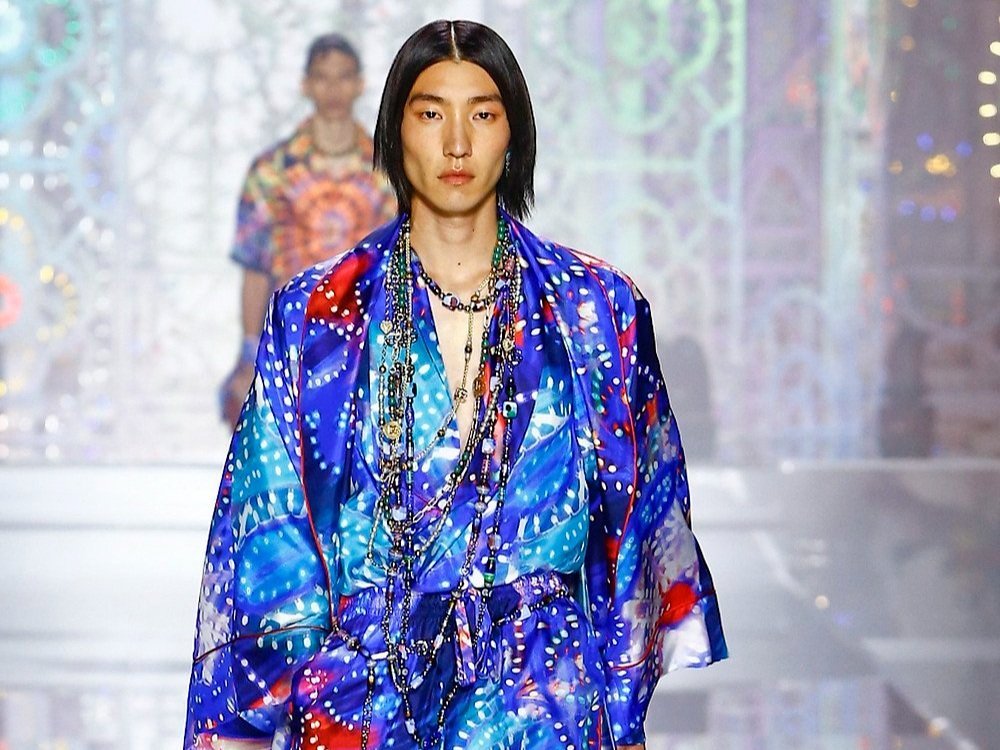
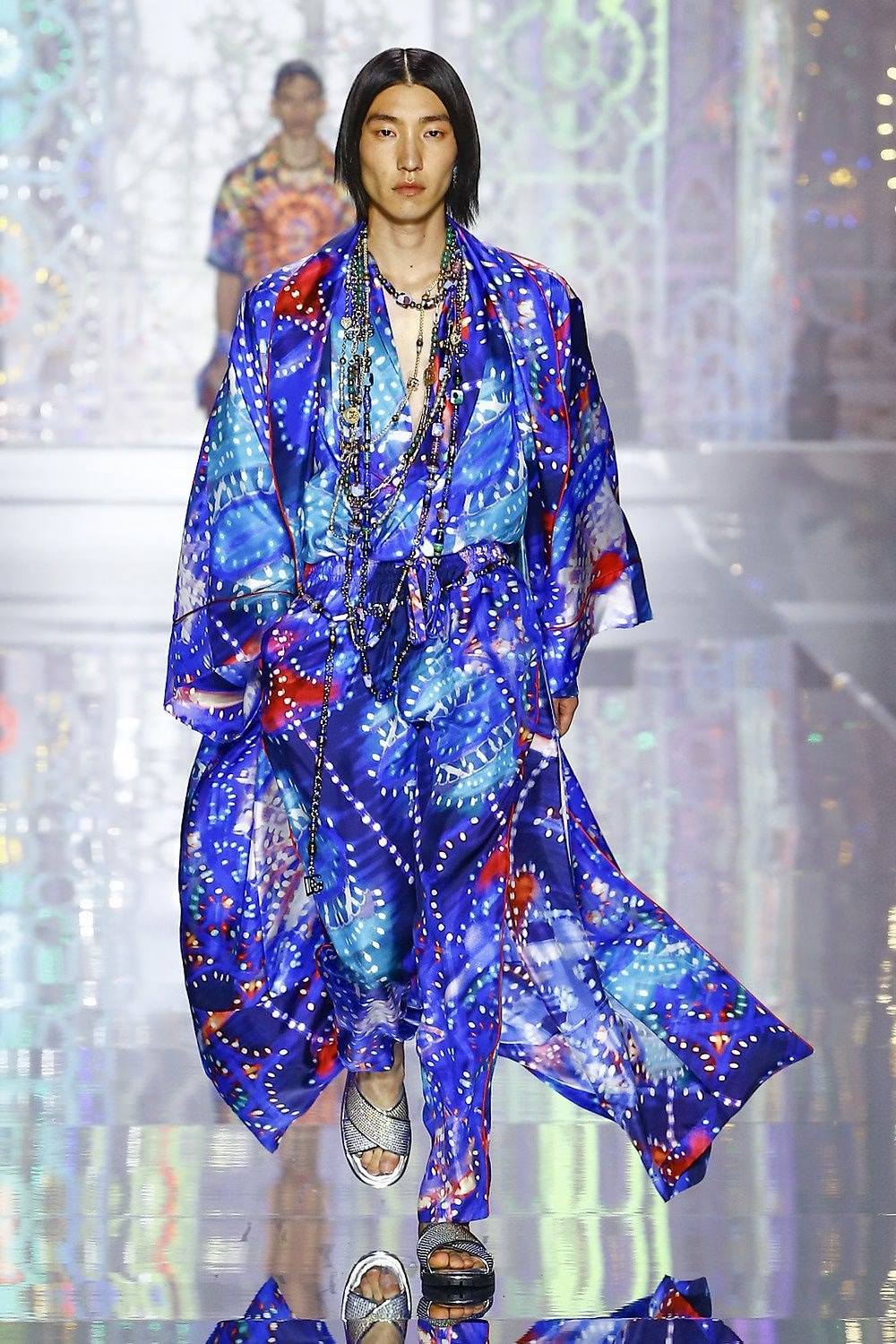
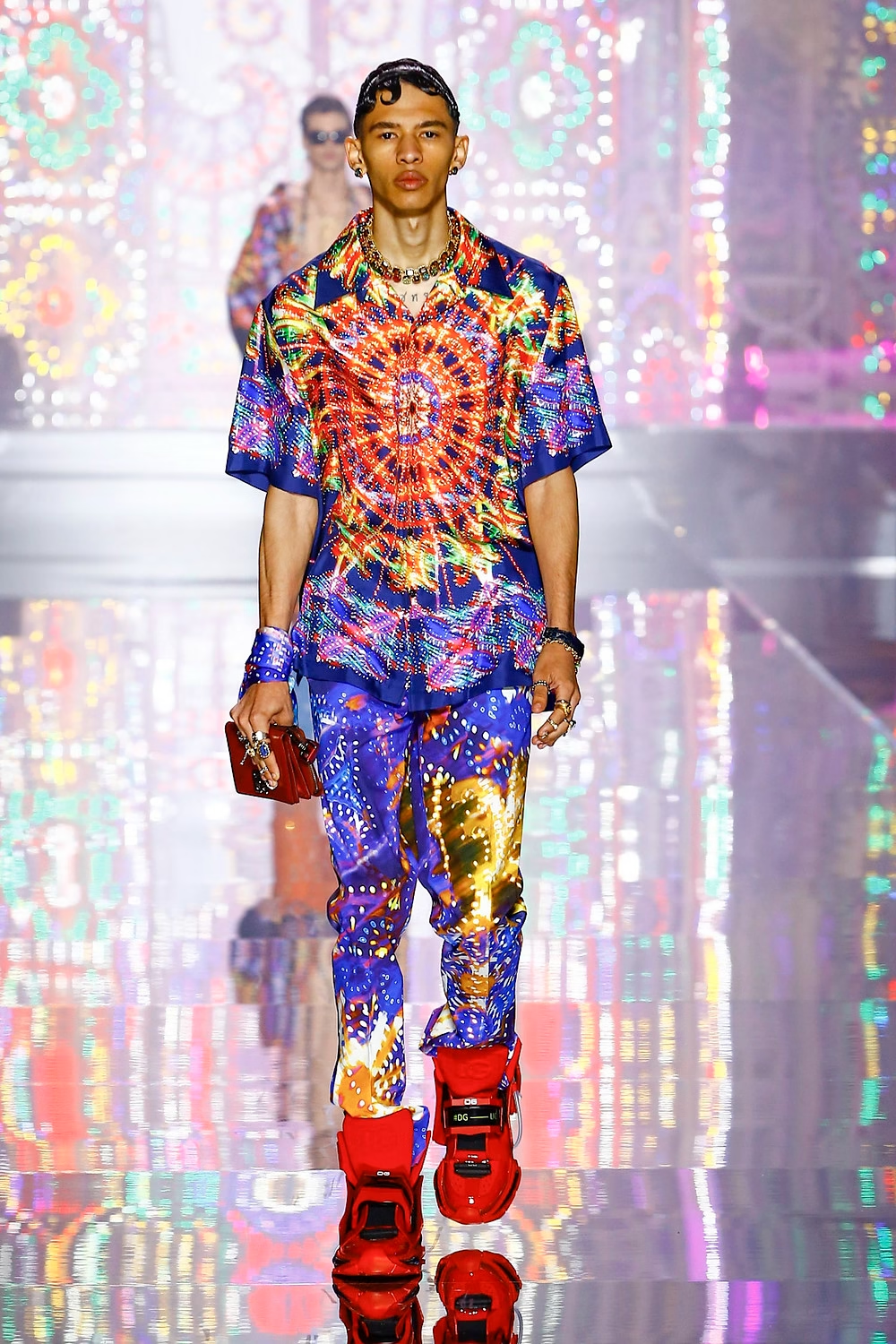
Dolce & Gabbana men’s spring/summer ‘22 collection catwalk show
The psychedelic renaissance wrote LSD off as impractical, fuddy-duddy, and just so, like long as to be downright subversive.
But tastemakers are trumpeting LSD’s versatility, while trendsetters are mining its aesthetic.
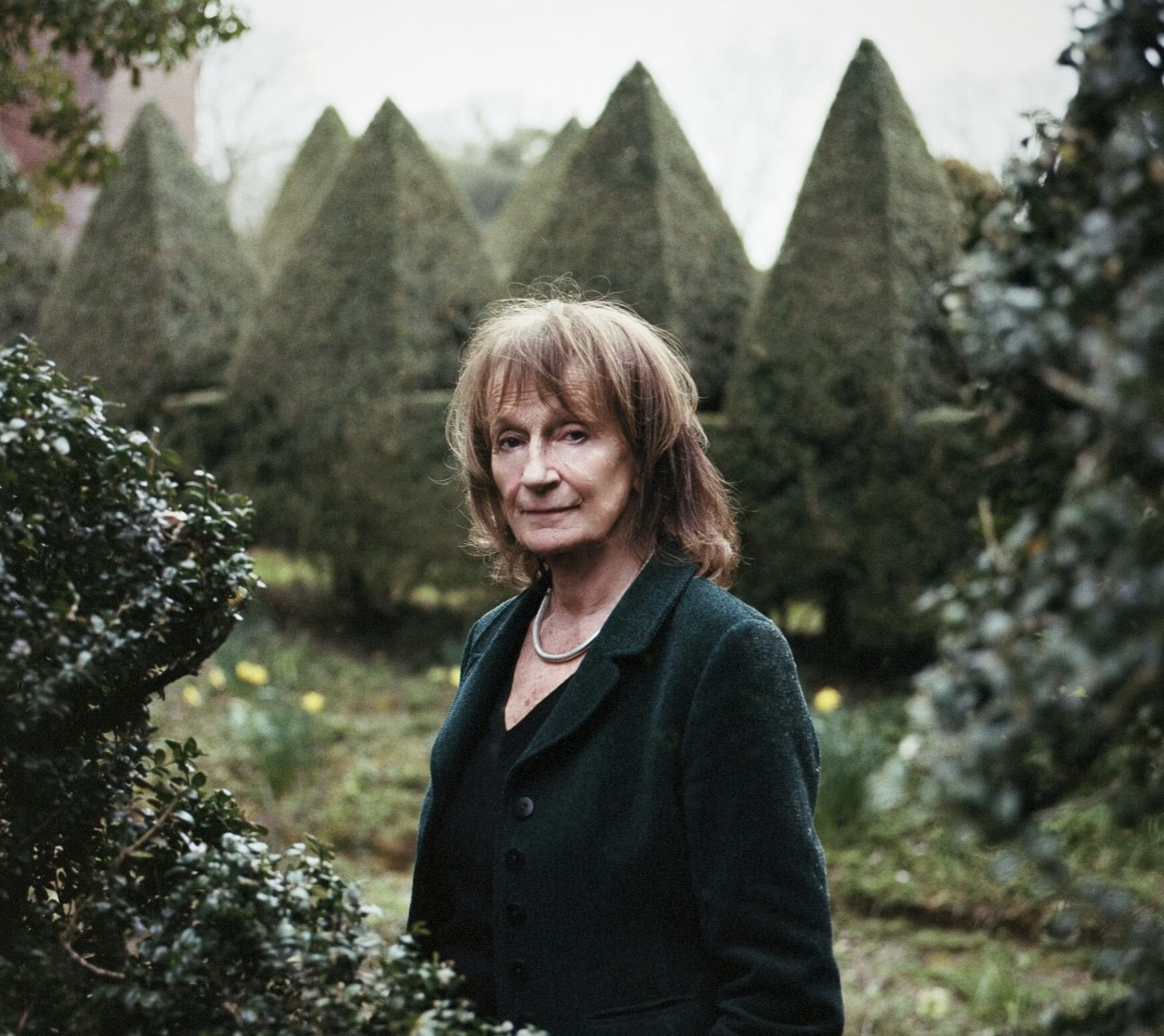
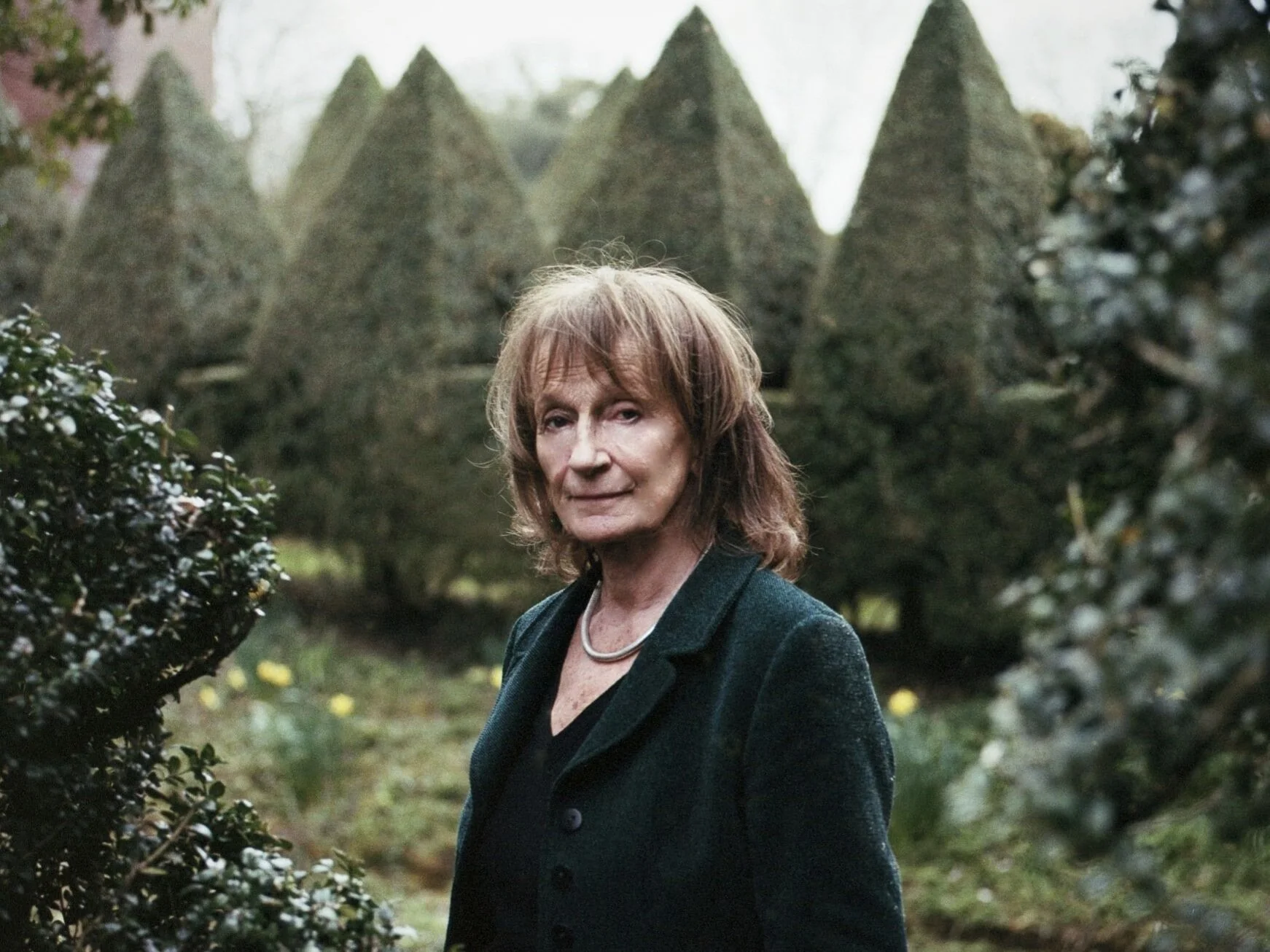
“To my mind, LSD is the best, the purest” declared Beckley Foundation’s Lady Amanda Fielding at the 2022 Psych Summit held at London’s National Gallery.
After all only the bohemian elite would have the time, right? And time is money more than ever before (usual disclaimers re: existence and/or nature of time).
One shudders to think that LSD is the new jet set drug of choice. Beckley are actually conducting the first serious test into microdosing with LSD. The old fave has also found favour with the restless rabble. MindMed’s stage two tests for ADHD are underway at 20µg of LSD twice a week, hot on the heels of its success with LSD for anxiety. MindMed’s base of Switzerland is the home of LSD after all.
Meanwhile, Milanese glamour powerhouse Dolce & Gabbana offers the trip-wear of choice for sartorial psychonauts in its spring/summer 2022 menswear collection. See you at the sample sale.
Dolce & Gabbana men’s spring/summer ‘22 collection catwalk show
Observations from my study on Vital and recent happenings in the space
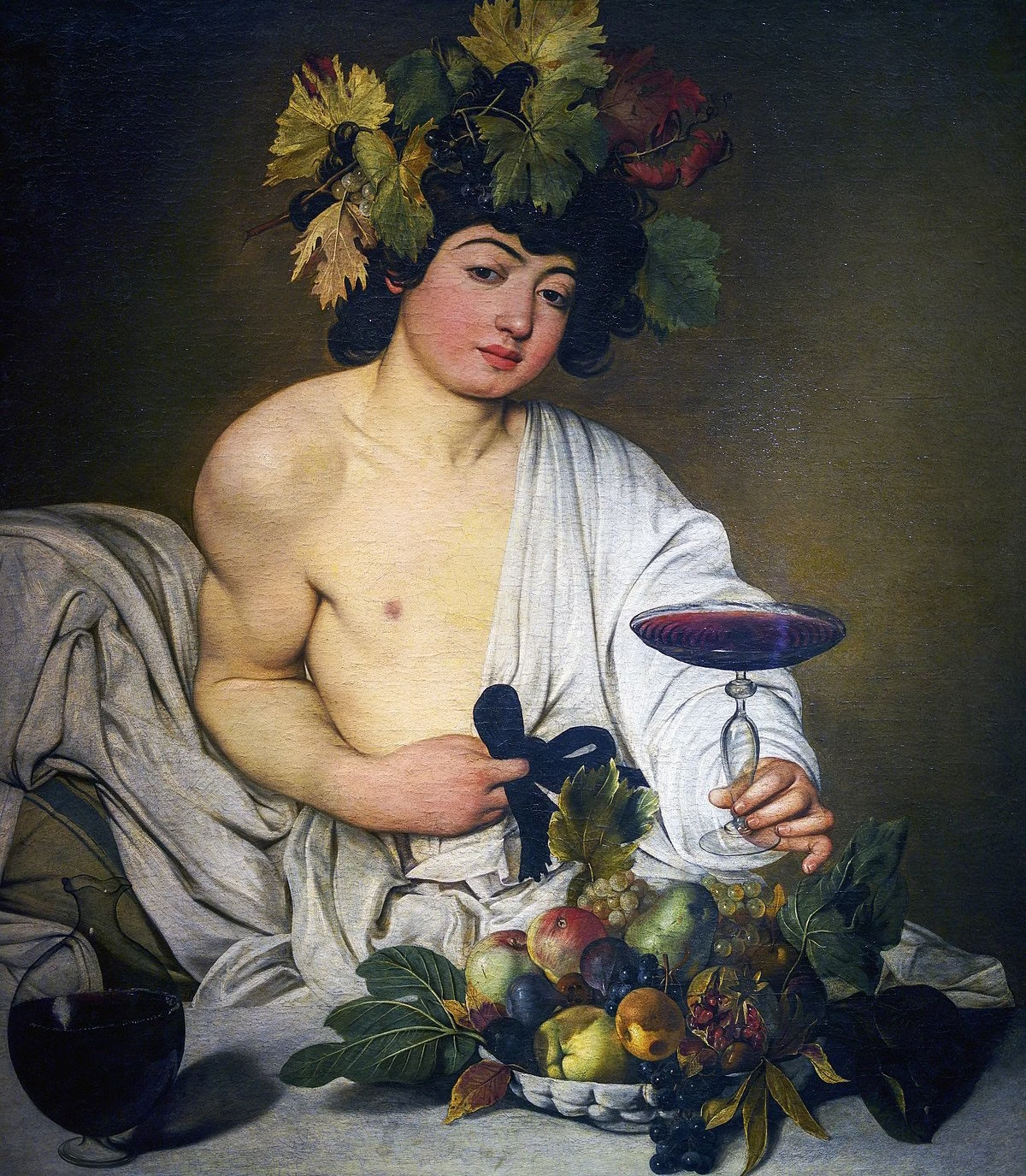
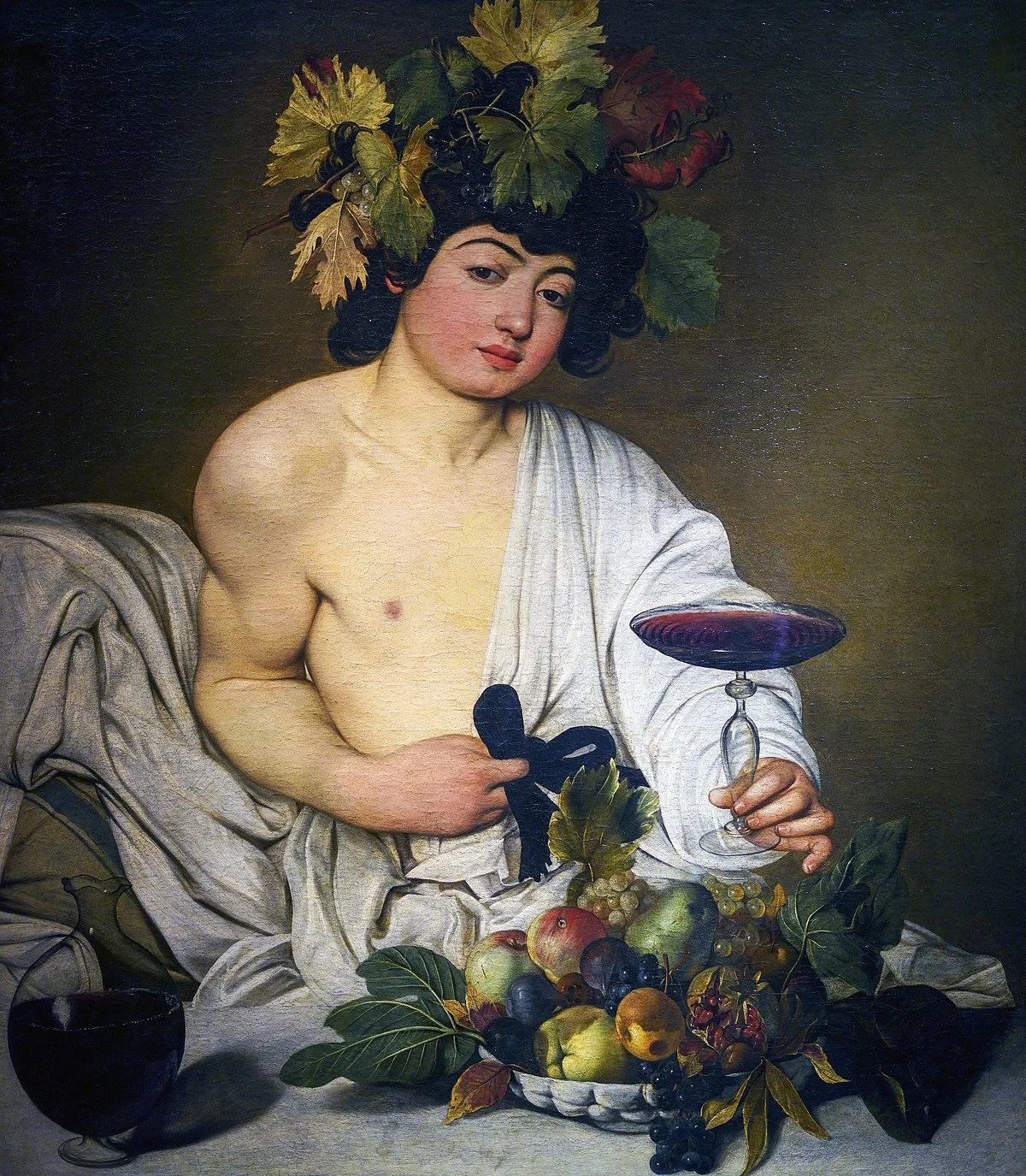
‘Bacchus’ by Caravaggio at The Uffizi, Florence
Consciousness expansion: from cave painting, to the pyramids, and the first Psych Symposium at London’s National Gallery. How far have we got?
In week three Vital students heard from Dr Lenny Gibson, a clinical psychologist, philosopher and breathwork pioneer with ‘50 years of experience working with non-ordinary states of consciousness’ who nonetheless fitted in a storied career and founded transpersonal psychology non-profit Dreamshadow.
Gibson’s winsome and poingnant presentation elegantly examined western attitudes towards conscious thinking. His key point was that the world beyond words is no less valid – more so, even – than what we can describe. Psychedelics connect us with our intuition: as represented by the ancient gods Cerrunos and Baal, the greek god Dionysus (Bacchus to the romans) and, yes, Jesus of Arimathea who ‘turns the water into wine’. The first art, storytelling and culture derived from rites around this divine archetype.
Gibson references philosopher du jourIain McGhilchrist, and I’ll pull out this particular quote from the Matter with Things author:
“As soon as you start saying anything about this realm, you falsify it. There are certain things that simply are resistant to normal language, normal exposition. But don’t for that reason not exist.”
But he began with a comparison to the Baka tribes whose genetics diverged 70,000 years ago. They describe their ceremonial group singing as “so beautiful the self melts away” just like both psychedelics and the ‘ecstatic’ techniques the rest of us have taken just as long to work out using science instead.
In the Zine this week, arranged in the synaesthesic schema used for Vital’s cirriculum:
Approach: Move any mountain with neo shamanism
Therapy: ‘Celebrating the mysteries’ is the new euphemism of choice
Space: Can you hold your own?
Medical:The Microdose Age
Integral: Learningtofly
Plus! Graph of the Week and second hand books
Approach
Move Any Mountain with Neo Shamanism
A neo shaman
The ‘S-Word’ is getting laden.
No surprise, when you consider that the criteria for shaman-hood range, depending on your understanding, from genetic lineage, grave dedication, and fighting spirits to cure treatment resistant diseases all the way to a dubious certificate, some bongos and an Instagram account.
‘Neo shamanism’ to Gibson is humankind’s recent ability to be his own wise counsel and medicine woman. The synthesis of LSD, a colourless tasteless substance able to inspire psychedelic states in minuscule amounts, he believes has democratised the role.
Poetically, this most scientific of revelations has inspired a rebirth of personal spirituality and philosophic examination. Scholars will point out that it’s the first time in 500 years, a la Joe Tafur’s Legend of the Eagle and the Condor, that science and religion have conjoined, whether in the form of transpersonal psychologist Stanislav Grof or the discoveries of quantum physics.
“For once, and for everyone, the truth was not still a mystery. Love called to all.”
Mystical healing may be associated with the Shipibo curanderos but they don’t use the word shaman themselves. In many communities associated with ‘shamanism’ the healer role itself is rare, considered apart, and special. Scientific medical training is not uncommon amongst indegeneous mystical healers.
Personally I understand exactly why usage is revered and not to be bandied about, certainly in an “I can cure you by battling with entities” manner. Gibson’s own understanding is that the neo shaman is a contemporary voyager into the new frontiers of the ‘Psyche,’ itself the name for the Greek goddess of wisdom and the soul. Obvious candidates for 20th Century LSD neo-shamanhood might be Grof, Aldous Huxley, Amanda Fielding or Jimi Hendrix. And Timothy Leary, who was scolded by RD Laing for democratising LSD… But if LSD had remained the preserve of the elite, Hendrix might never have wrote in his personal poetry after Woodstock in 1969, “For once, and for everyone, the truth was not still a mystery. Love called to all.”
Mankind’s destiny calls, and we are all ordained to answer.
Therapy
‘Celebrating the mysteries’ is the new euphemism of choice
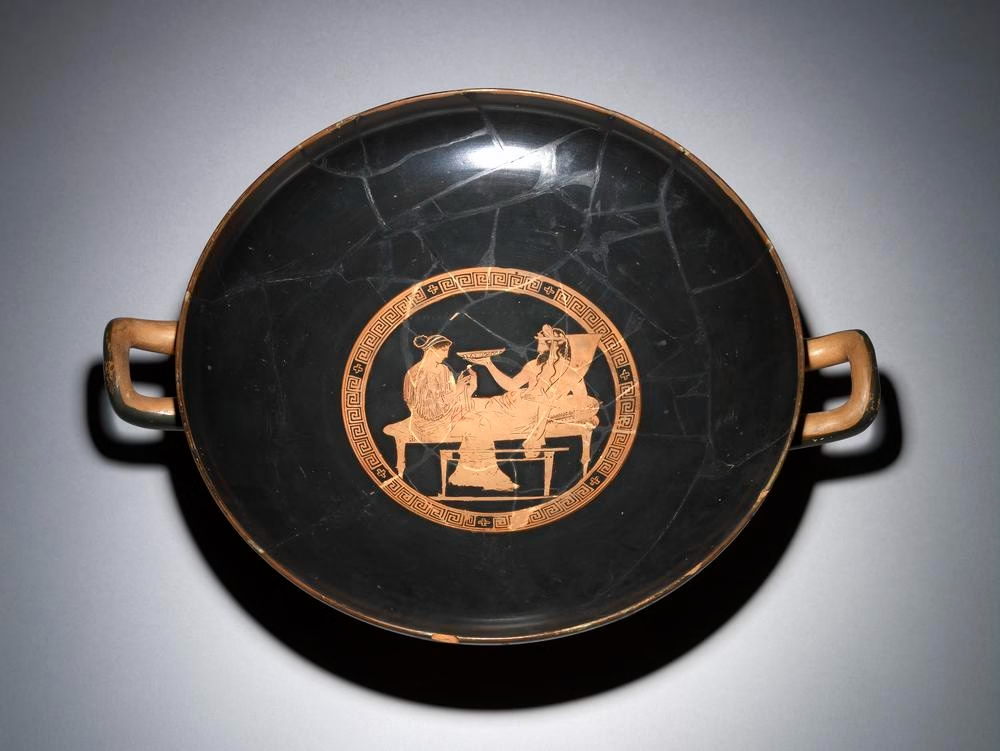
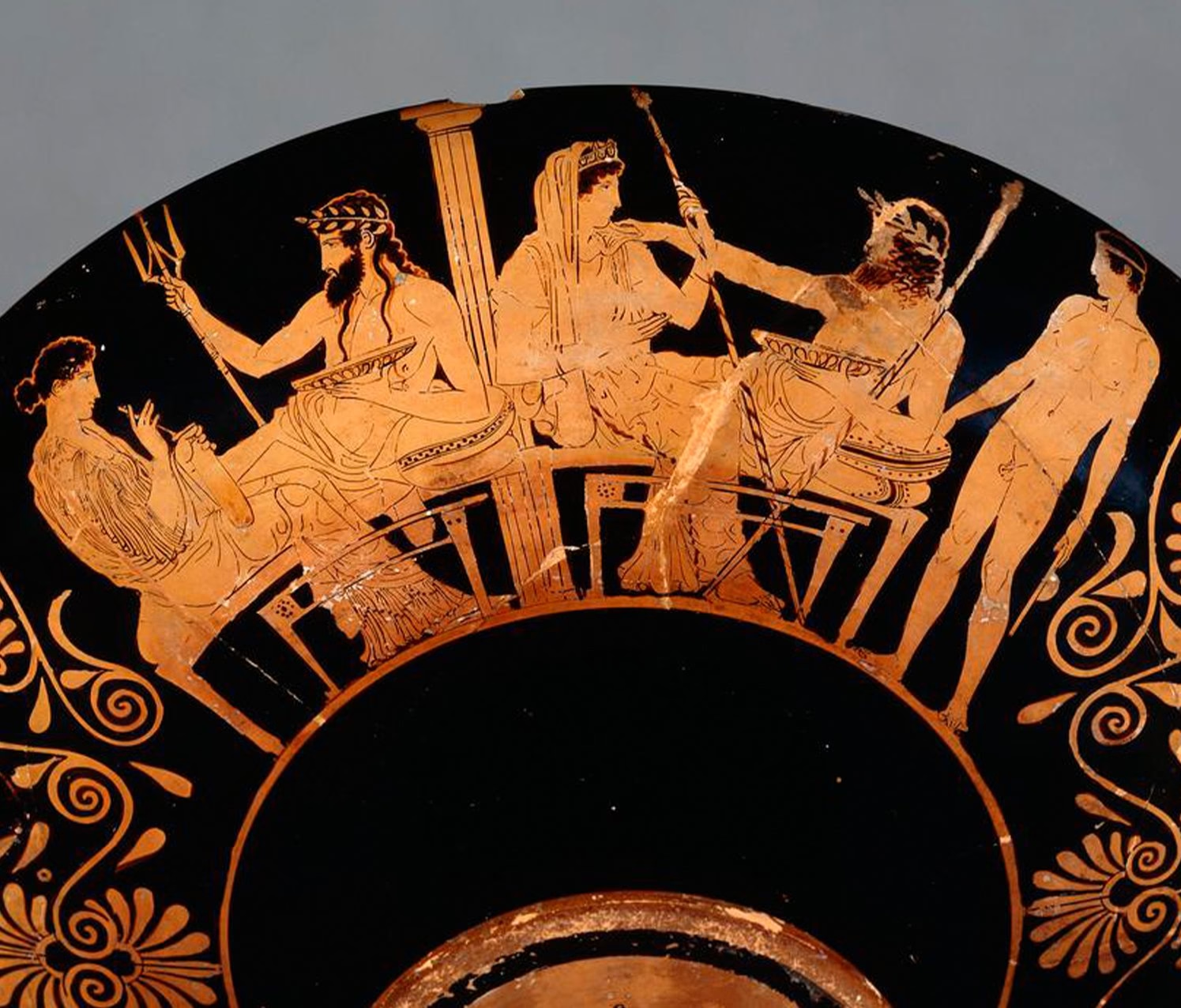
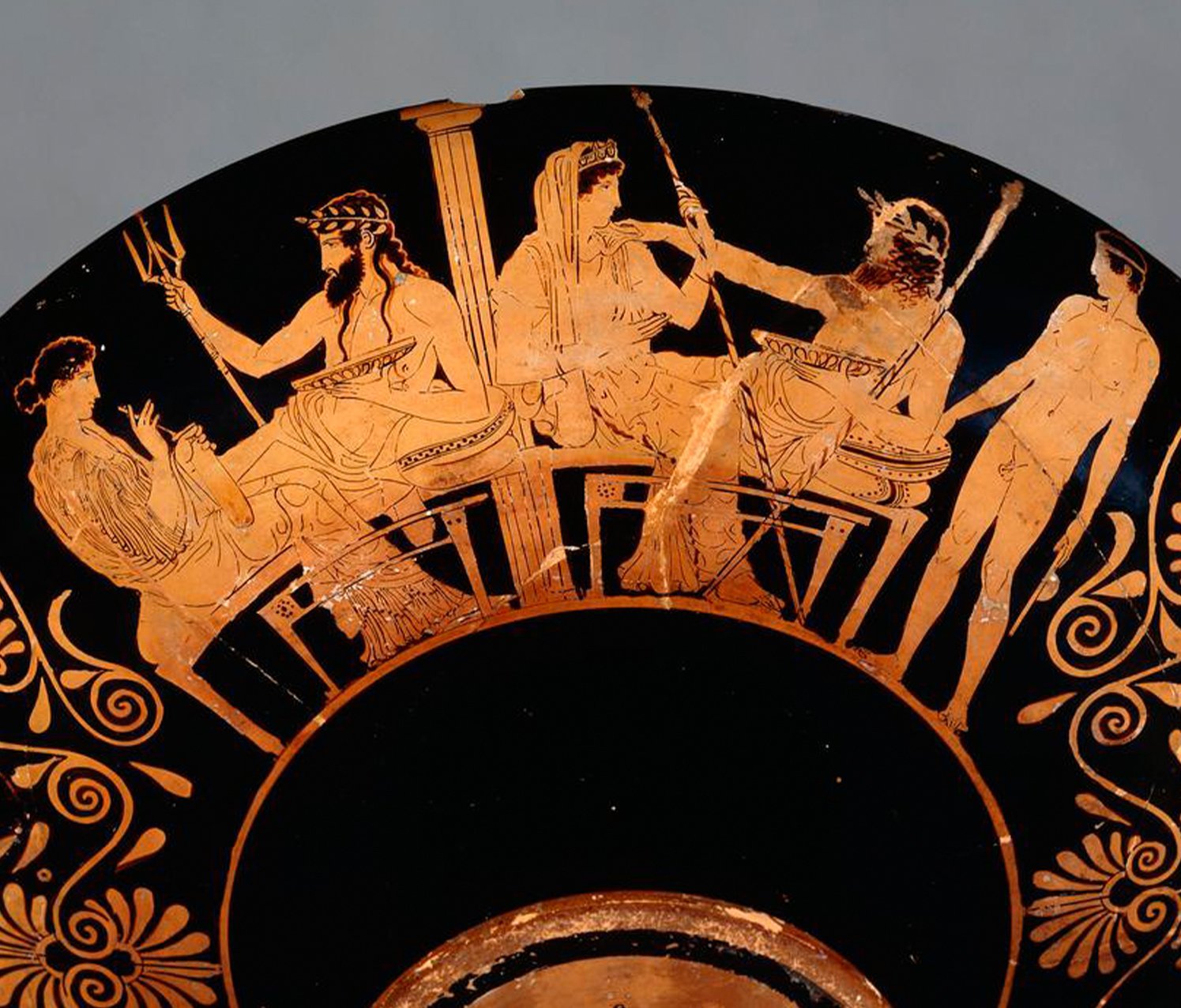
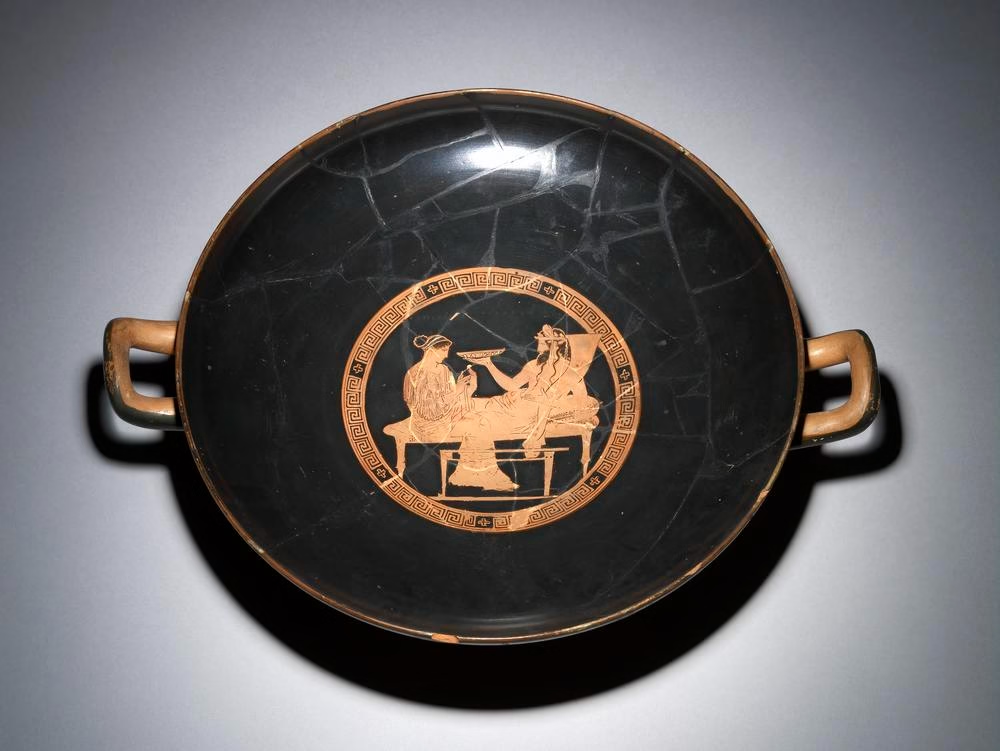
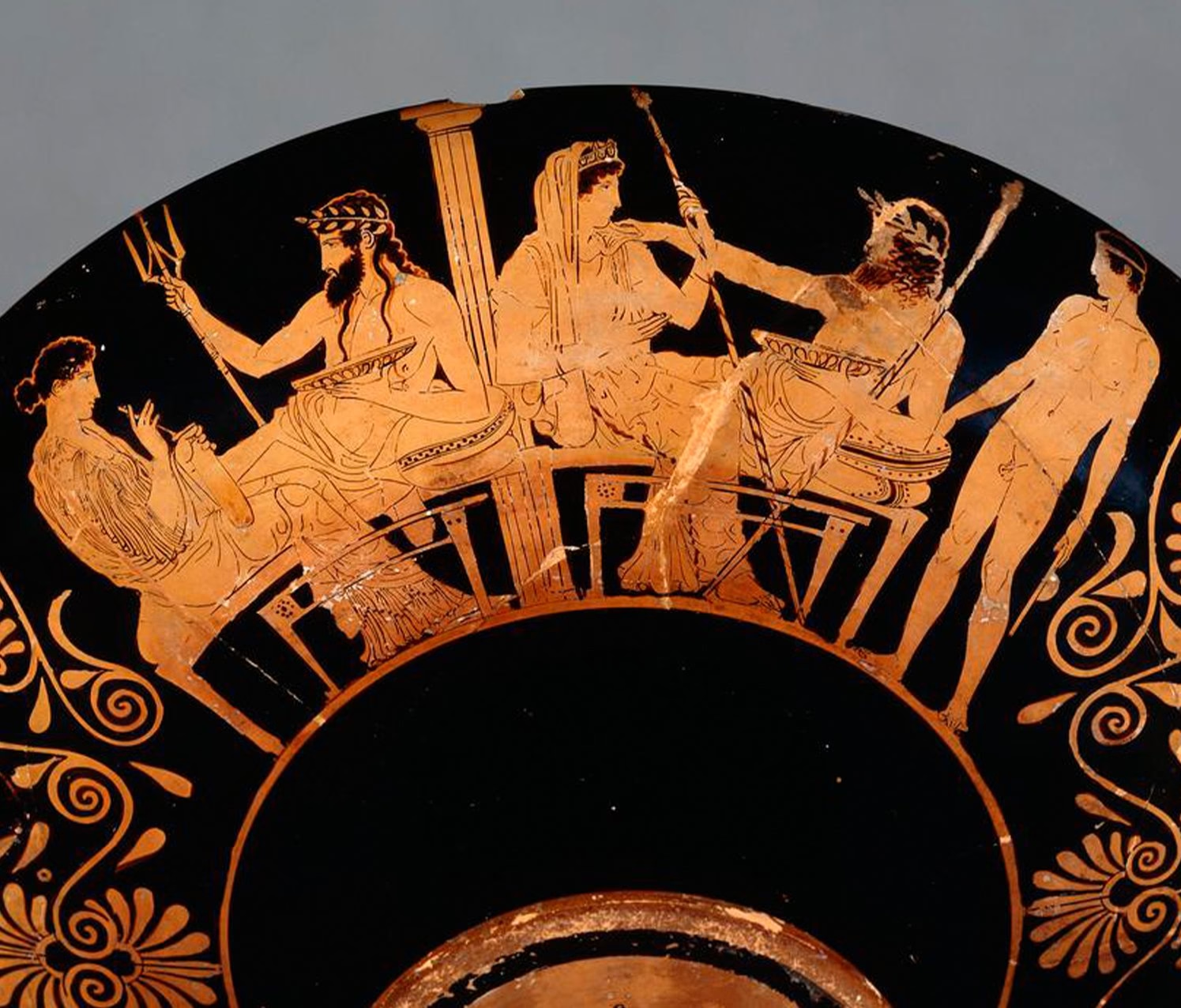
Above and below: kylix cup depicting Hades and Persephone from 430BC now in The British Museum
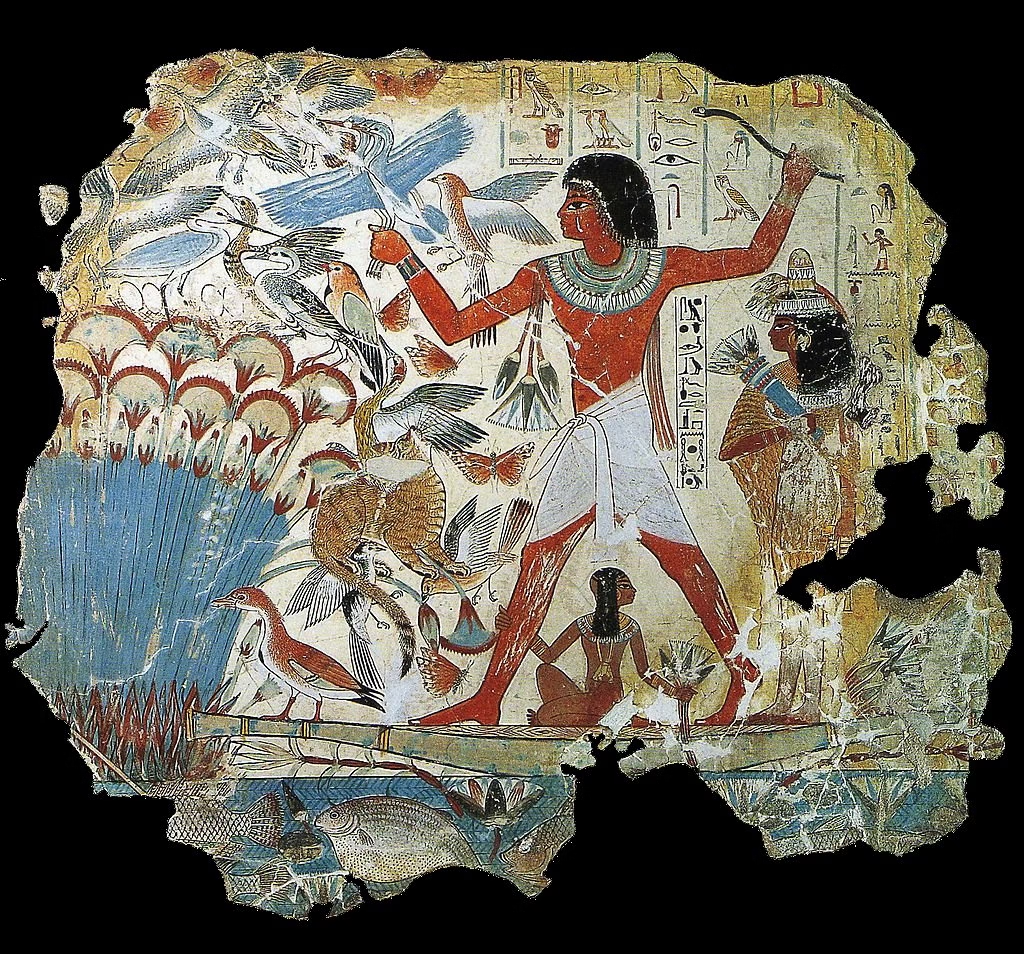
Ancient Egyptian Viagra: blue lotus flowers from the Tomb of Nebanum
Accessibility is a hot topic in ‘the space’ right now.
At the inaugural Psych Symposium in London’s National Gallery earlier this May 2022, itself undeniably elitist at £400 for a basic one-day ticket and £1,000 for full access and the drinkies, MAPS spokesperson Natalie Lyla Ginsbergtold suits that “PTSD is most common in the marginalised communities who cannot currently access these treatments.” Author Zoe Cormier eviscerated corpos with lines like, “So if it’s okay for somebody dying of bowel cancer to grow their own mushrooms, why is it not okay for normal folks?” (Answer: ‘because dosages’, to a lack of any audible groans).
The Greeks famously all tripped together at the Eleusinian Mysteries, an invite-only annual bash held at the festival of Demeter for the best part of two thousand years. It’s heavily referenced in Shakespeare’s esoteric play The Tempest. Supposedly ‘The Mysteries’ was reserved only for the ‘invisible college’ wyrd and wonderful types, but high society were in on things too: “The beautful people following the interesting people, and the rich people follow the beautiful people” as a wise lady once told me. Indeed, the use of psychedelics was only proven recently when a gruelling, decades-long investigation into the local availability of psychedelic ergot was trumped by legal records prosecuting a notorious socialite for ‘celebrating the mysteries’ at dinner parties back home in Athens (he got exiled to Sparta, by the way). Current podcast staple Brian Muraresku will tell you all about psychedelic use by the early Christians. And has been recently in great interviews like this around his book The Immortality Key.
The ancient greeks believed “Life can only be experienced in a truly terrifying, but transformational, encounter with death.”
Ritually, the Greeks supped from elaborate kylix cups (above). Medieval witches got rampant on datura, best taken internally via the mucus membrane, by inserting it vaginally – ‘riding the broomstick’. In 2022 ketamine bumps are delivered in £5,000 inhalers, and while no one is sticking DMT up their bum just yet, the common folk are hunted and persecuted by the agents of mediocrity still.
Space
Can you hold your own?
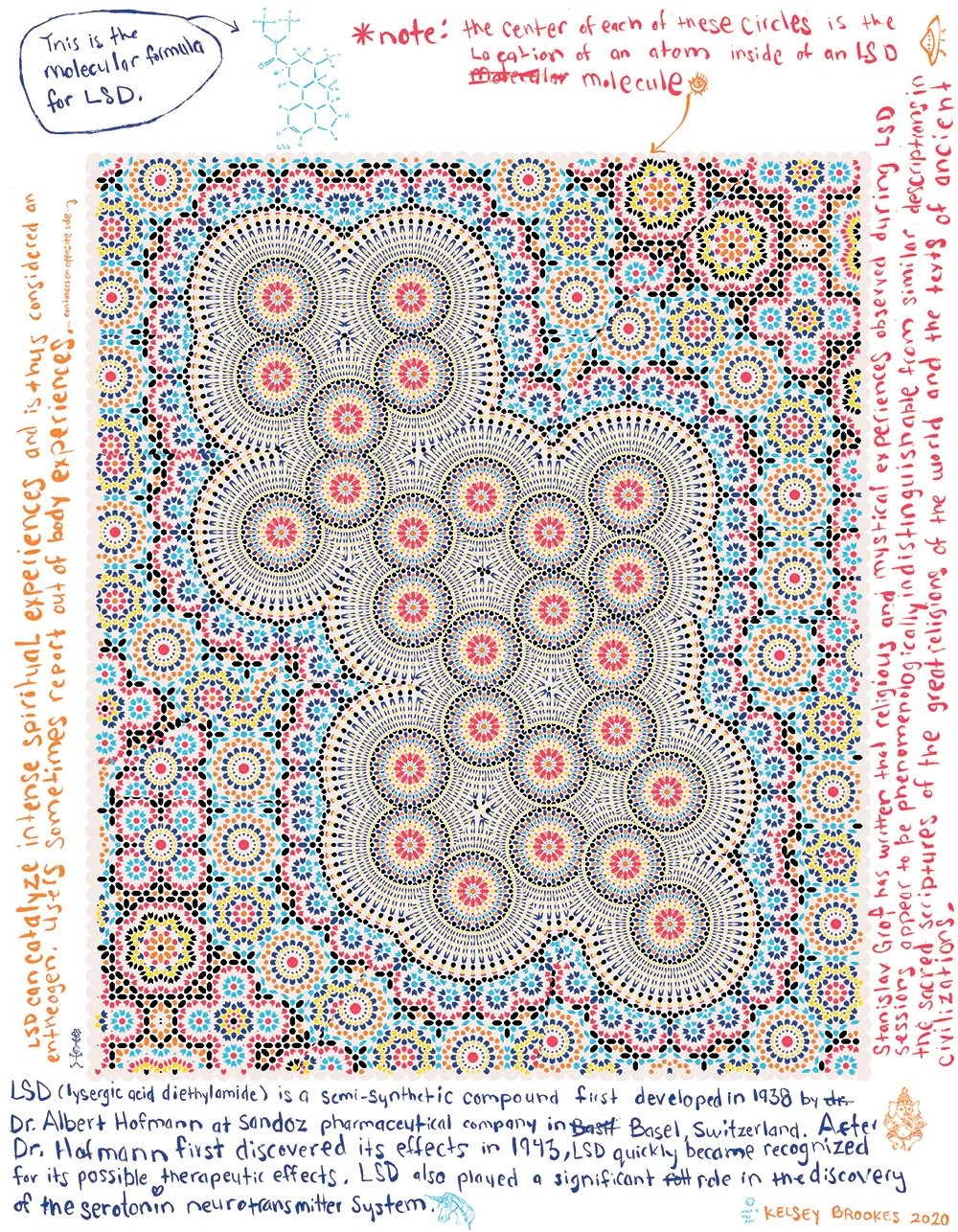
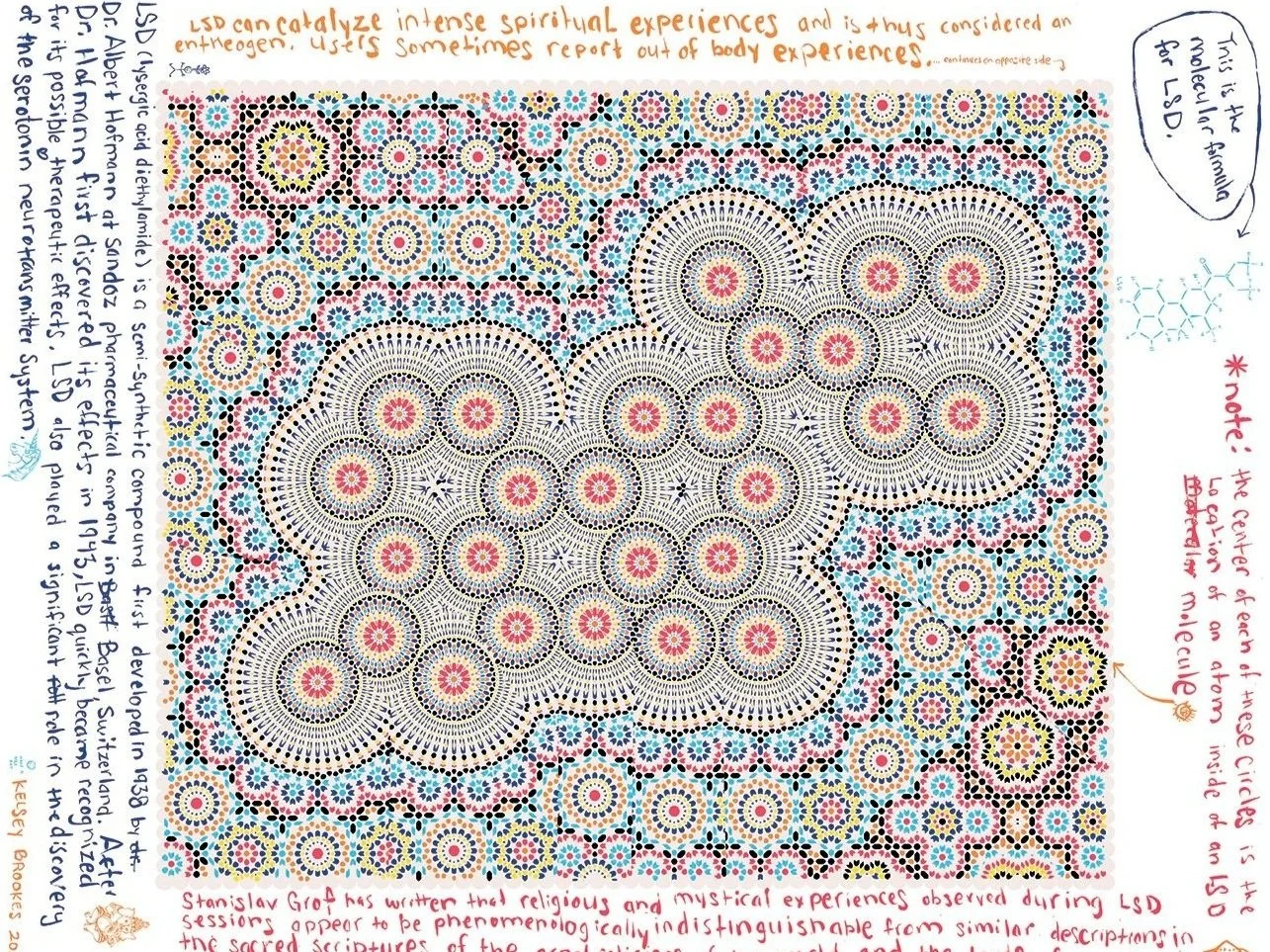
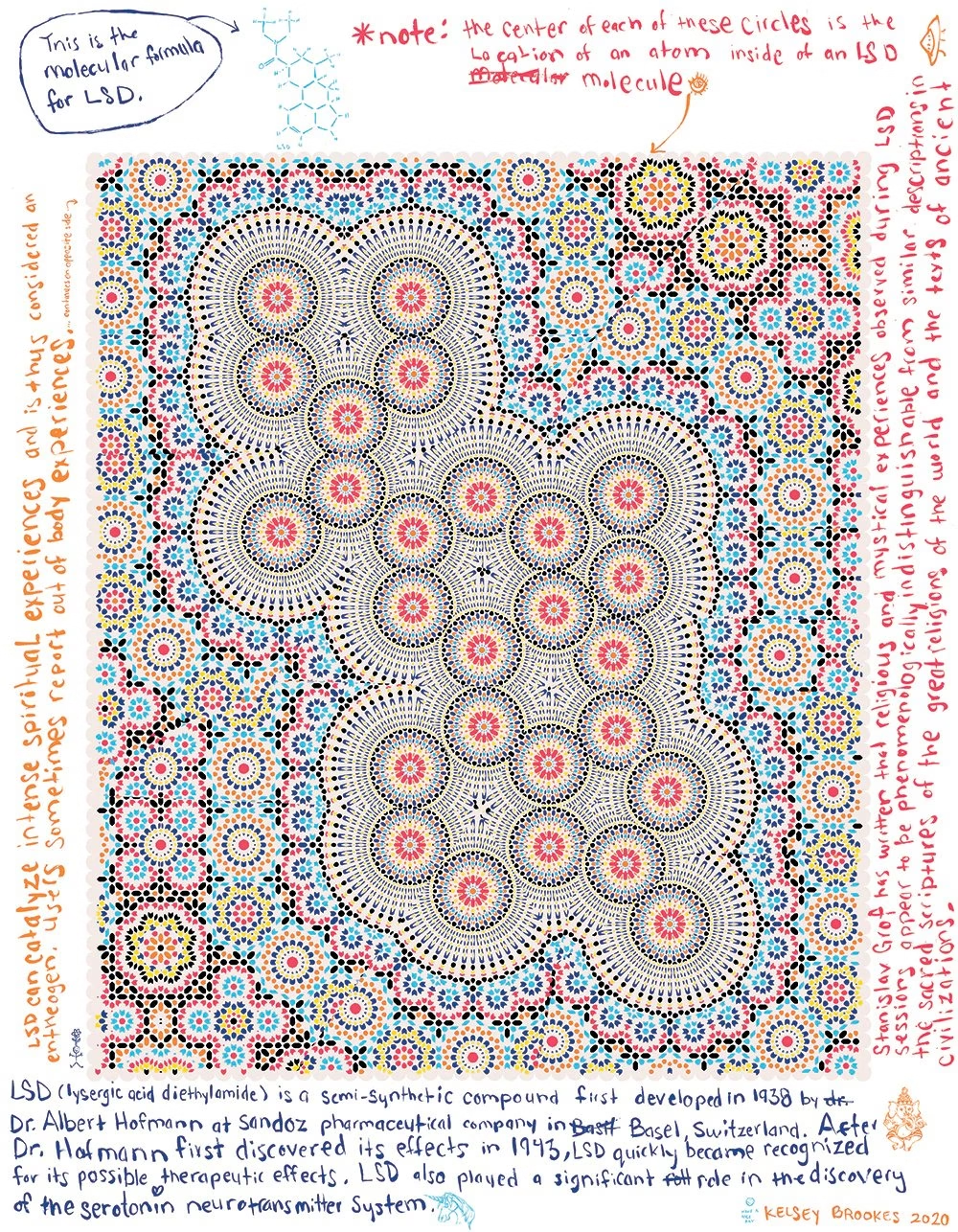
Kelsey Brookes, LSD Poster, available here
Westerners are sorely lacking in psychedelic ritual.
The Imperial College testing rooms are the most British thing I’ve ever seen, with a blanket thrown over the studio kitchen in the corner, a drape with some trees on and a lamp stuck behind it, plus some spiritual tat.
It does look surprisingly cosy nonetheless, especially with Dr Ros beaming angelically from her seat in the corner. But you almost certainly have to dream the Albion way to appreciate its understated succour. Bar the open heartedness oozing from the ever-radiant Dr Ros, being served the Mysteries by the priestesses of Demeter it is not. Neither is donning a blindfold plus headphones, and boasting a grin like the one that betrays the fact you don’t normally fly business class, an experience surely at all comparable to the jungle ayahuasca one.
12-step style integration and ceremony – my bad, ‘celebrating the mysteries’ – circles were mentioned as future possibilities by Psych delegates in a huddle with Imperial College trials participants Iain Roullier and Leonie Schneider, unsung heroes of the UK space who also spoke onstage with Dr Ros repping their PsyPan set-up. In the meantime there is… an app.
“The substance is only 51% of the process”
‘Holding space’ doesn’t seem to have been much of an issue during contemporary scientific tests and education regarding bad trips-stroke-challenging, purgatorial experiences may take the edge off them so to speak. Admittedly a guide, let alone a skilled psychotherapist or shaman, may be good for a bad trip too. Because surely MindMed’s ‘off switch’ jab is cheating*.
An old pal has just reminded me that our sitter was a table leg with an acid house smiley face drawn on it which we kept in the back of the van. The Wild Hunt rides.
*Take the off switch if they offer it or at least don’t say I told you not to
Medical
The Microdose Age
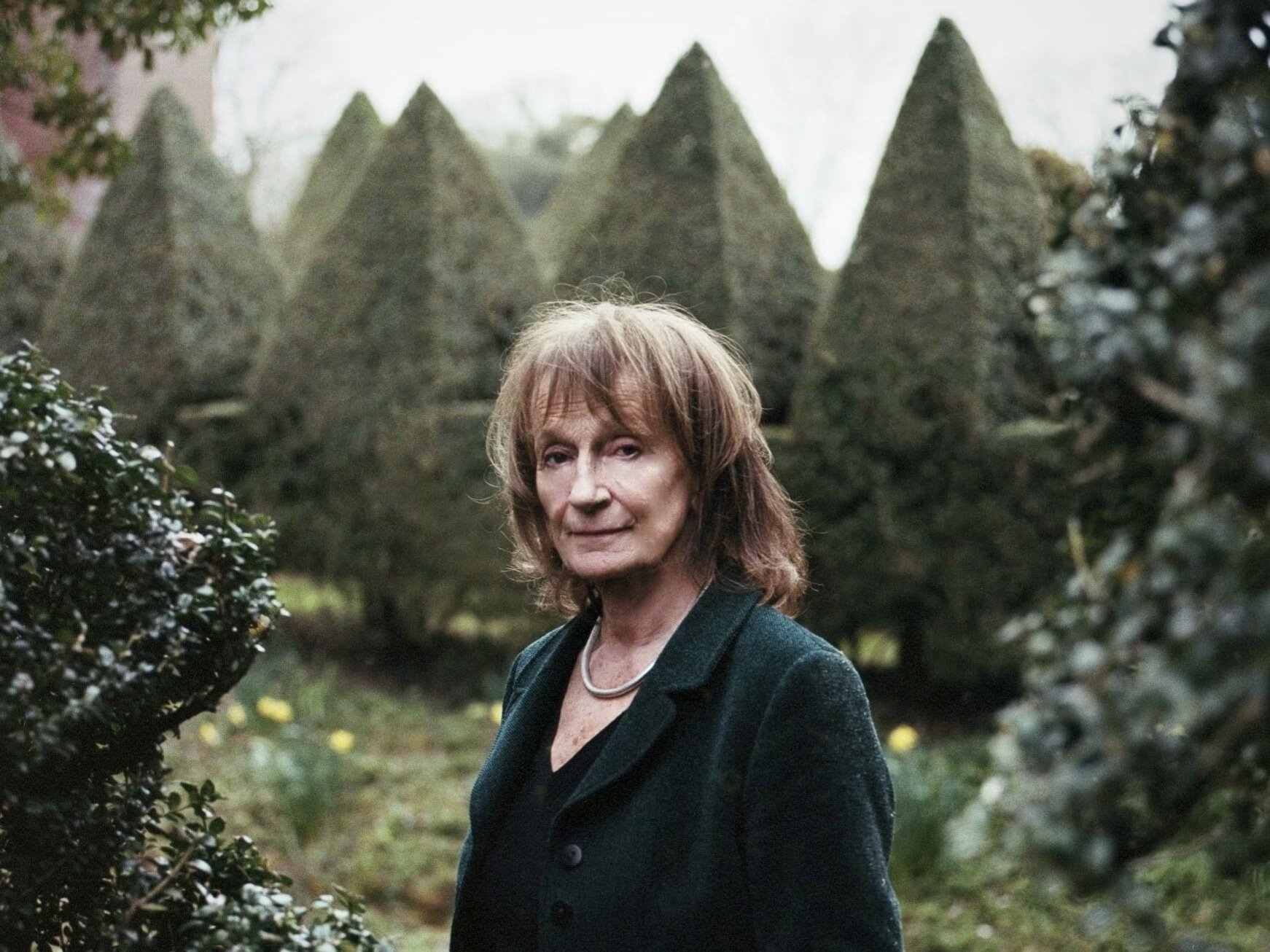
Lady Amanda Fielding of The Beckley Foundation and now Beckley Psytech
“Microdosing is a step forward for humankind.”
Beckley Psytech’s Lady Amanda Fielding (for it is she) declared so at Psych Symposium. If psychedelics can be for the everyman, can they be for every day?
While it’s less spectacular than ‘spiritual doses’, DMT, or ayahuasca, and an ongoing science to say the least, microdosing’s arguably taken a stronger foothold in popular culture than the next-level psychedelics. Users report similar effects to integrated major experiences, like enthusiasm, geniality, consideration and walking in the woods while listening to Jon Hopkins. Famously though microdosing – which Beckley are researching throughly – is one of the few contemporary psychedelic phenomena to fail the placebo test. Small doses are being tested on some conditions: MindMed are on stage two for 20µg of LSD twice a week, while sticking someone in a room and giving them a proper tab (200µg) did okay for GAD . The likes of New Health Club are poised to bring acid to the workplace (at last). Lenny Gibson’s observation was that ‘psyche’ also means ‘breath’, and Stanislav Grof’s holotropic breathwork could be the only option – and also a better one – for many.
Professor David Nutt pointed out in his Psych presentation that it’s the ‘wellbeing’ scores that are really impressive in psychedelic therapy’s efficacy results. But according to a neuroscientist I spoke to outside when the fire alarm went off, “there are no criteria for developing drugs for ‘wellbeing’ like there might be for mental health conditions already treated pharmacologically. So everybody’s trying to make drugs, which is ruinously expensive as it is, without knowing precisely what to aim at, certainly in terms of approval.” The Mushroom Nation is at once already here, and still so far away.
NB Psychedelics are prohibited in most places even if labelled ‘cacao’ and sent in gaudy packaging. You can still get busted for them like this guy.
I n t e g ra l
Learningto fly
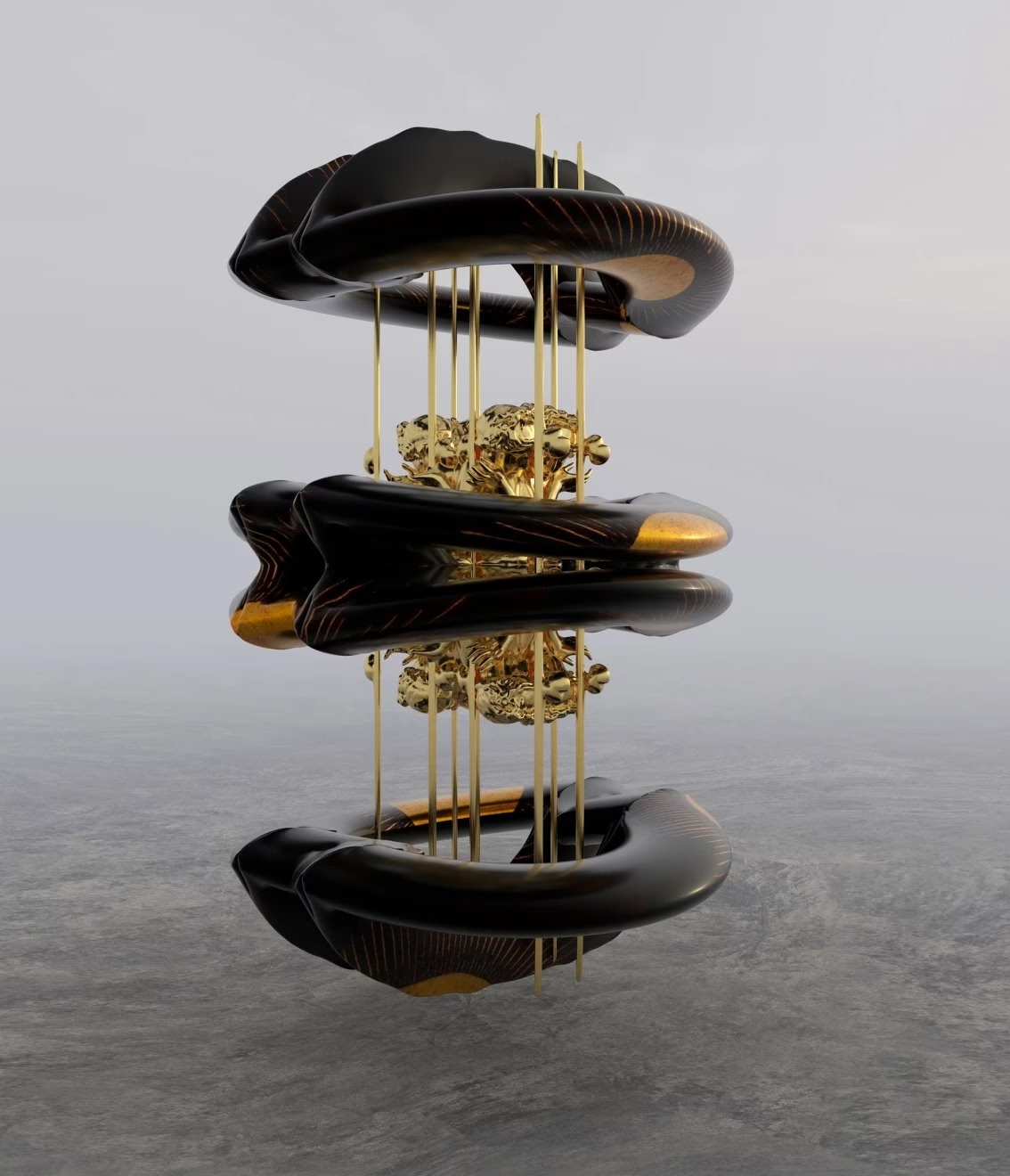
‘Hyperbolic Depth’ by Wolfe Von Lenkiewicz available here
“The substance is only 51% of the treatment” said Imperial College Psilodep 2 trial clinical lead scientist Dr Rosalind Watts at Psych Sumposium.
It was vehemently echoed by the PsyPan patient support group alongside her on stage at London’s National Gallery. Blasting off into hyperspace is not entirely the point either reminded week four Vital lecturer Dr Lenny Gibson, who evoked Stanislav Grof:
“The ecstasy of a noumenal moment, a psychedelic intoxication, is not enough for mysticism. Such a moment comes to nothing if it does not become part of a process of lived expression and expressed thinking.”
Less than a week previously Dr Ros launched her Acer Integration project at the Earth Centre in Hackney. It’d take a heart of stone not to give the team at Acer credit and I, for one, liked the singing in the round. The mystic is sorely lacking in European research as Dr David Luke points out, and metropolitan Londoners, their dopamine receptors worn down to ichorous stubs, are polarised in their spiritual awakening or total lack thereof. I suspect it might be better for many if we stick to burning massive effigies and people just ‘get it’ on either a collective unconscious level or whatever.
Meanwhile the stock images of millennials in the blindfold and headphones are beginning to look sinister, I reckon. Once again I find myself drawn to the intriguingly complex MAPS PTSD therapy programme, where the mystical concepts so potent for healing trauma must be dealt with ever so sensitively, because the soldiers have been driven far further from God than even my neighbours in this modern-day Babylon (I like London really; non-dual thinking).
“Be kind to the guy at the grocery store. Make new friends. Put the art pedal to the floor.”
While veterans and the treatment-resistant depressed crave healing – and should go to the front of the queue – the rest of us scrabble for meaning, humanity, or merely playfulness. Nonplussed yet fascinated by doxa, Plato’s term for shallow concerns, we struggle to ‘participate in eternal totality’ as Spinoza urged. Raves, ‘sex positivity’ and Burning Man-type festivals are our attempts to break through. And ‘meaning making experiences’ may indeed prompt a breakthrough or two, but that will only be the start of a long and confusing journey for some.
Others, like us BJJ bores and Dragon’s Den/Shark Tank wannabees, ponder our lack of the right kind of trauma, that sweet spot sought by Neitsche, Jung, and others who rarely left their desks.
The greeks did put down their books. Even Plato excelled at wrestling, competing at the Pytheon (like The Championship in English football) and Isthmian games. Both of which featured culture and sport combined incidentally. Immortality Key writer Brian Muraresku says in this great Lex Fridman interview that the greeks were also fond of saying, “Life can only be experienced in a truly terrifying, but transformational, encounter with death.” He quotes Huxley on mass radical self-transcendence and deeper understanding. Plus Alan Watts on authority being threatened by mass outbreaks of mysticism.
Myth, or ontonolgy if you like, in the West and far beyond teaches that less thought is better than more. Lenny Gibson’s lifestyle advice: “Be kind to the guy at the grocery store. Make new friends. Put the art pedal to the floor.”
Kool-Aid Corner
To finish: trippy clippings, merry pranks, and psychedelic student life
Graph of the Week
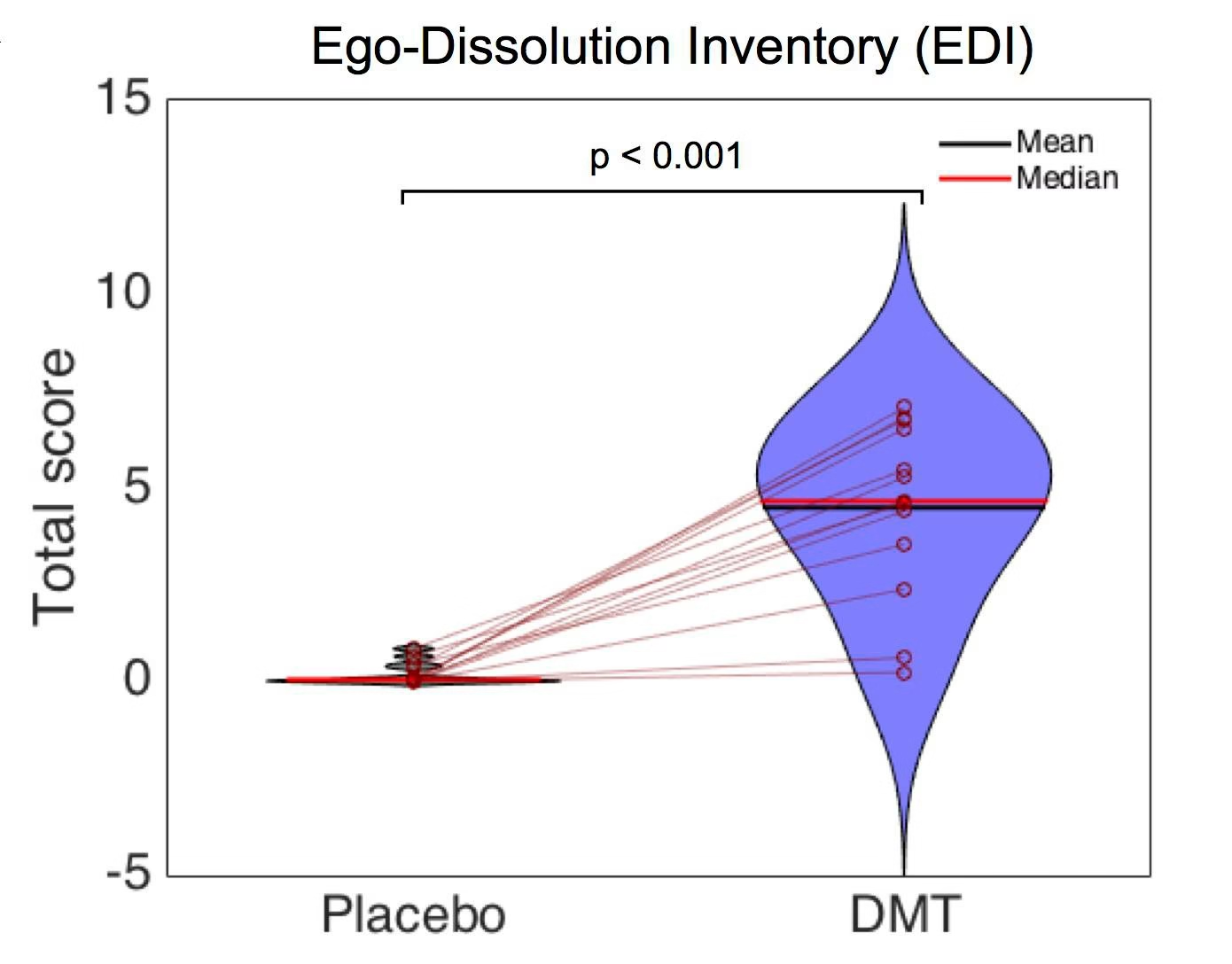
Ego-dissolution scores of test subjects
On DMT
Placebo
From: DMT Models the Near-Death Experience, Christopher Timmermann, Leor Roseman, Luke Williams, David Erritzoe, Charlotte Martial, Héléna Cassol, Steven Laureys, David Nutt and Robin Carhart-Harris (Frontiers in Psychology, August 2018)
My bookshelf weighs a ton
Notable new purchases for the occult library. Strictly second hand snap-ups only
This week: Listen, Little Man! by Wilhelm Reich with illustrations by William Steig
£6 once 60p
What flirtation with western neo shamanism would be complete without a reminder that the boy who points out the emperor has no clothes is actually banished to the wilderness? It’s only in the modern version he becomes king. Other innovator-pranksters like Reich, and Plato’s favourite Socrates, end up dead.
Reich never intended for this 1945 manifesto to be published. This 1977 version features incredible illustrations by William Steig, who’d go on to write Shrek. Reichian bodywork is part of helotropic breathing and bioenergetics is taught in schools.
It’s more relevant than ever for detoxifying western armouring, but undoubtedly too much like hard work for most. Homemade orgone accumulators at the ready for a pssible comeback nonetheless. Buy my teacher’s new book on Reichian Character Structure to get going, it’s brilliant.
Next issue: John Hopkins’ Dr Bill Richards talks 60 years of LSD
This blog is not directly affiliated to Vital beyond my study on the course. The content shouldn’t be taken as representative as it’s a personal reflection and includes my own lived experience of the sector too.
Psychedelic drugs are prohibited in the UK, other countries and most US states. I do not condone their use nor am I evangelising for, or recommending them to you. There are more qualified people you can turn to in the Resources section but if you are considering psychedelic treatments the best person to speak to is probably your own therapist, counsellor, or doctor.
To finish: trippy clippings, merry pranks, and psychedelic student life
Graph/visual aid of the Week
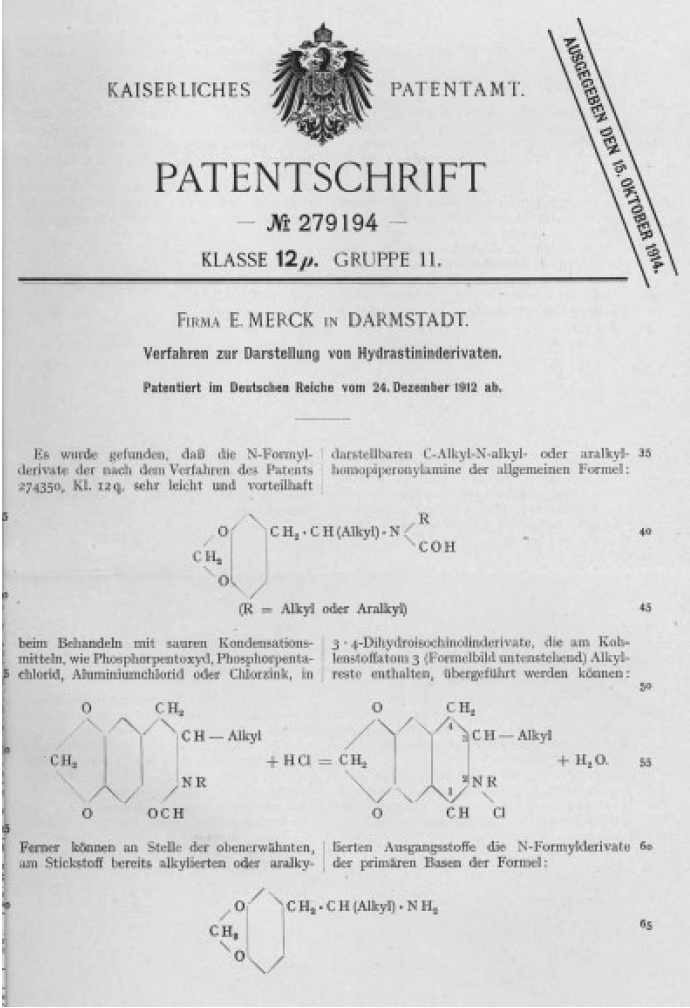
The first patent for MDMA
From: The Rave: Spiritual Healing in Modern Western Subcultures by Scott R Hutson (Anthropological Quarterly, January 2000)
My bookshelf weighs a ton
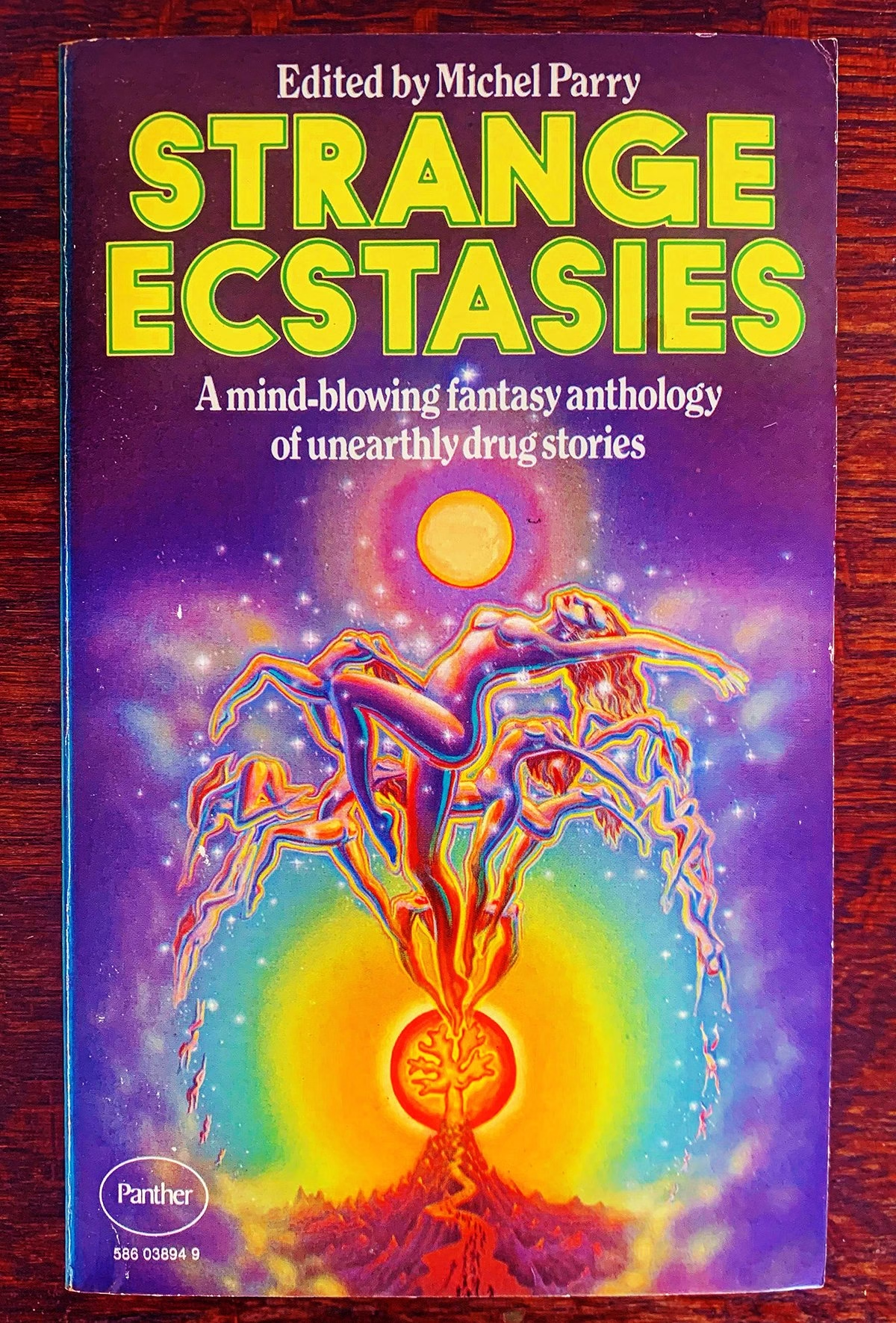
Notable new purchases for the occult library. Strictly second hand snap-ups only. This week: The Archaic Revival by Terrence McKenna.
£25 usually £100+
Stories of space narcotics by major authors collected by druid of derring-do Michael Parry (d. 2014) , including The New Accelerator by H G Wells, Subjectivity by Norman Spinrad and What to Do Until the Analyst Comes by Frederik Pohl.
Plus a superb cover naturally.
If you like this sort of thing and haven’t read The Employees, a 2020 Booker Prize nominee by Danish author Olga Ravn, a ‘disconcertingly quotidian space opera’ (The Guardian), do so at light speed.
I can’t look at books like this without being hauntd by a sci fi short story about a co-ed college on a space station where the boys get these pets called teasels. I couldn’t find any reference to it online which was chilling in itself.
Next issue: Dr Rick ‘The Strass’ Strassmangoes further than ever before… several times
Observations from my study on Vital and recent happenings in the space
Celia Vasquez Yui, ‘The Council of the Mother Spirits’ via Salon 94 and Shipibo Conibo Centre
In Vital’s second lecture Dr Joe Tafur blew minds with a clinical overview of shamanic plant medicine healing. It included his staggering current research into conditions possibly related to epigentics that range from PTSD to cancer.
The family doctor from Phoenix, Arizona is also a shaman in the Shipibo curanderismo tradition trained by Maestro Ayahuasca Shaman Ricardo Amaringo. He’s the author of ayahuasca blockbusterThe Fellowship of the River(‘with introduction by Gabor Mat´é’) plus theco-founder alongside Amaringo of Nihue Rao healing centre near Iquitos, Peru.
In the Zine this week, arranged in the Vital cirriculum’s colour scheme:
Approach: Saving souls for three million years
Therapy: The art of healing
Space: Sing your song in the key of life
Medical:Epigentic disease and plant medicine
Integral: The EagleandtheCondor
Plus! Graph of the Week and second hand books
Approach
Saving lost souls for three million years. Now, with MDMA
Graciela Arias Salazar, ‘La Virgen del Capinurí out of @centro_selva_arte_y_ciencia via Antricion gallery in Zurich
Dr Tafur saw ayahuasca’s positive effect on beleagured veterans.
He took this as a validation of his own conversion to plant medicine after ayahuasca was instrumental in his recovery from a depressive episode.
He told Vital students that transcendent unconditional love, of the kind received in a sacred ceremony, has a positive effect on psychoneuroimmunology (PNI) just like family love (the good enough kind).
It can be transmitted via ‘limbic resonance’ – a theoretical term for hormonal interaction between one or more people. With its support our subconscious processes difficult emotions more efficiently. The healing effect moves from the psyche (P) through the nerous system (N) into the immune system (I), bolstering the body’s own intuitive ‘inner healer’.
The importance of empathy has recently been recognised within western medical treatment. But we are all understanding that professional clinicians can only give so much of themselves.
However. Try instead exotic ceremonies, remarkable locations, skilled practicioners, devout participants, and zealous dedication in the form of the ‘only was out is through’ strategy of taking high-strength ancient jungle acid five nights in a row – and you have the missing element required to treat a range of psychoneuroimmunologically-related conditions currently frustrating doctors and destroying families.
The spiritual sector, to its eternal credit, provides the social role of offering salvation to those mired in confusion, or paralysed by ethical quagmire. It can provide rare complex moral reconciliation, of the kind that PTSD treatment benefits from enormously. Where though does MDMA come in? It’s an ‘empathogen’ as opposed to a psychedelic.
Nonetheless the ‘love drug’ too can augment some characteristics of psychotherapy just like psychedelics and traditional healing ceremonies. Not only does MDMA increase the level of limbic resonance between doctor and patient, it’s also been shown to activate areas of the brain used during childhood to ingrain healthy social behaviour patterns.
Besides, “The MAPS PTSD programme going up for FDA-approval has a mystical element,” sa Dr Tafur, responding to my disbelief that western psychotherapy can rapidly replicate the awe of ayahuasca, “in my experience the clinical sector is increasingly intertested in ceremony. There are some really open-hearted therapists at MAPS,” he expands, referencing the completely accepting nature of spiritual fulfilment… historically known as ecstasy.
Therapy
Psychedelic therapy is an art first and a science second
Anderson Debernardi, ‘Ayahuasqueros Healing’ available here
“It’s living in the jungle for four months, eating right,” says Tafur, “You can’t read it and write it.”
You can train to be a shaman with Dr Joe! But there’s what would be considered, in this modern world, a catch: you actually have to go and do it.
Even for psychotherapits practicing MDMA therapy at MAPS, Dr Tafur points out, “There’s no running away when you’re in there with people who have these issues for eight hours.”
Whether delivering the icaros in that delightful yet dread-laden way, or deftly reaching out with your neuroceptive aura, Dr Tafur is keen to stress, “this is an art.”
A powerful combination of the sacred, the empathic, and experience in healing epigentic-related conditions is central to his hypothesis (see Medical below). It’s why the clincial sector is fascinated; even in this 1950s archive footage a researcher asks his test subject “how does your soul feel right now?” Plus it’s also why ravers aren’t cured of mental health issues after a big weekend – context and other important characteristics are key to the drug experience having a self-healing element. The spiritual factor prompts an ever deeper form of self-healing when combined with the therapeutic. “Current medical science cannot match the transpersonal, or the moving,” says Dr Tafur.
‘Psyche’ in classical greek means ‘soul’. Dr Tafur explained that indigenous perspectives consider spirituality and healing to be one and the same. Music, prayer, ceremony, connection and affirmation: all augment the ‘spiritual experience’ that research shows is key to healing with psychedelics.
Space
Songs in the key of life: energy and entropy
Irene Lopez, ‘Fantastic Guest’ works available via her site
Mystic healing is far from an established vocation in the West. And the spectre of cultural appropriation casts a deep shadow.
But there’s a gulf between Instagram ‘shamans’ and the type of grassroots work conducted for example in communities affected by the opioid crisis, where very well-intentioned and ultimately effective healers face risks of incarceration and rupturing their own community relations.
How then can mystical healing’s beneficial elements be adopted by western health and wellbeing practicioners?
Apprenticing under an authentic expert would likely involve the path taken by, for example, Reiki healers who are also encouraged to search and wait for the correct master, and may need to prove their dedication upon finding them.
“It’s about real people and some real conenction that you might have,” says Dr Tafur, “What opportunities do you have around you? Where are you? Is there somebody in your area where you can explore that?”
There are nonetheless fundamentals to the approach that can be considered. MAPS training assets for example refer to the importance of the therapist exuding ‘loving presence’. And somatic experiencing (which Dr Tafur recommends) coaches are trained to cultivate a ‘neuroceptive aura’ radiating a sense of safety to encourage ‘interoception’ a constructive dialogue between the body, emotions, and conscious thought.
“We’re trying to help somebody, and using our faculties as human beings in order to do that,” is what Dr Tafur distills the healing process down to. During his lecture he was hardly dismissive of authentic western efforts to replicate the process – but it’s essential that these are conducted with an ‘open heart’.
Singing icaros-type songs with substituted words in a shared language is not misguided… as long as it creates the required atmosphere for a mystical healing window to open. Sincerity of feeling is essential, but localised interpretations may be actually more effective than exotic traditional ones.
The most graceful nuances of ayahuasca are said to be ontologically lost on outsiders. Occultist Jason Louv points out that eastern spiritual systems like buddhism are guides to living well in different cultures. In response to social media claims that ‘Putin should take ayahuasca’ to end the Ukraine conflict, Shaur-trained shaman and former financier John Perkins recently pointed out that the experience is traditionally believed to make fiercer warriors to highlight how we can’t overlap a different approach entirely onto our own worldview. Tactics specific to western society may have more impact on local patients, if conducted with the same levels of intention, craft and sensitivity.
The “energy” to quote Dr Tafur directly is what is key – its purity of purpose and its intensity. Icaros have an improvised element and he himself will substitute spanish or english words if required. Nonetheless the language has a vocabulary that is ideal to express the ayahuasca experience, as does the rhythm – but this itself features aspects that might well go over the heads of anyone who can’t claim lineage in the local society and culture.
Equally any expert will tell you that it is best to learn an established system before beginning to develop your own. Dr Tafur feels that his traditional Shipibo education gives his practice, “A strong base. But I’m interested in singing for patients undergoing ketamine therapy for example. So there’s room to mix it up. But there must be a reason why. Is it because it’s better for your patients or just because you don’t like tradition? Learning something well, then applying it elsewhere is more powerful than just coming up with whatever.”
Europeans have been feverishly dreaming up a shamanic culture using both fact and myth for the past few centuries, resulting in for example Wicca. They have also looked to the future in the form of ‘chaos magic’, a method of creating personal spiritual systems based on esoteric techniques passed down the millennia. Even a traditional ‘christian mysticism’ featuring, for example alchemy is in vogue now thanks to writer Damien Echols.
All this will still be a massive culture shock for the average agnostic westerner seeking alternative healthcare, especially hipsters raised on Richard Dawkins (who also has his place). But often the psychedelically-active patient will have become curious about these areas allowing for fundamentals to be touched upon at least. In 2015’s Transcendent Mind (see bottom of page) published by the famously orthodox American Psychological Association, Drs Imants Baruss and Julia Mossbridge present serious, rubber-stamped research that pairs ancestor worship with the collective unconscious and (I paraphrase) ‘that way you know your parents are about to call just before the phone rings.’ Refer to that last bit and riff from there…
To end. Experts like Dr Ido Cohen point out that the shamanic path is a calling as opposed to a blessing. Like other (supposedly) rewarding life paths, it comes with its own trials and sacrifices. Dr Tafur says, “if this makes you feel special, like you’re right and others are wrong, it’s not working. It’s suppsoed to make you feel part of something, working together.”
Medical
Spiritualhealing could help cure epigentic diseases and transform treatment
Plant medicine fan favourite Pablo Amringo
“Ultimately we’re reopening metaphysics. The research is in review now and we’re looking forward to sharing it with the world,” says Dr Tafur.
Modern Spirit, Dr Tafur’s non-profit org has collected genetic samples from some of the 107 patients in MAPS’ 12-month MDMA therapy trial (see above) where a stunning 68% of patients had statistically recovered from chronic, treatment resistant PTSD after three treatments. They’d been suffering for an average of 17.8 years.
“To a doctor, the sacred isn’t important. But to close your mind is a hiding place. People need to see something. Mental health? It’s competitive. But cancer is largely epigenetic and that’s one of the fields they’re saying they want to put more energy and understanding into.”
The research could also validate other holistic practices ranging from somatic experiencing to reiki.
“Ultimately we’re reopening metaphysics. The research is in review now and we’re looking forward to sharing it with the world,” he says.
He recounts a pivotal moment in his shamanic career, when ayauasca visions insisted that a penitent’s disease was “on” as opposed to “in” her genes as medical consenus assumes.
This tallys with the compelling field of epigenetics, which examines changes in our DNA (nature) brought about by environment (nurture). These can be passed down the generations, and include traumatic experiences. This was proven by landmark surveys using data assembled from descendants of Holocaust survivors. Of course it also works for colonialism, industrialised warfare, poverty, patriarchy and lovelessness. It’s a new and complex but far from fringe area: my mother is an identical twin who has been taking part in NHS epigentic research funded by good old Wellcome Trust for decades.
I n t e g ra l
The EagleandtheCondor
By Fellowship of the River cover artist Rai Weni
‘The Eagle and the Condor’ is a two thousand year-old propehcy that could be said to predict the colonisation of the Americas, the resulting cultural holocaust, and a re-emergence of mystical healing techniques.
The peoples of the Condor – indigeneous Americans – and the Eagle, western colonisers – will finally come together ushering a new paradigm of enlightenment.
Columbus’ First Voyage landed in the Carribbean in 1492. Syncronicity fans note that in 1994 Terrence McKenna published Food of the Gods and Dr Allan Schore released Affect Regulation and the Origin of the Self.
The aforementioned Shuar shaman John Perkins has alluded to the propehcy as prompting a shift from the West’s ‘Death Economy’ based on competiting over limited resources to a ‘Life Economy’ where wellbeing is paramount (in our abundant era, the Death Economy is arguably so past its due that its basis in scarcity has even had to be simulated by, for example, western governments implementing policies to artificially raise house prices).
This prophecy is not uncomparable to Western astrology’s Age of Aquarius (which both Carl Jung in Aion and Aleister Crowley with his ‘Age of Horus’ suggested will have a non-dual flipside, but that is for another day).
The prophecy offers the very seductive idea of ‘Pachakuti’ a time of reconciliation and healing. But is it real?
“Who knows what’s real?” says Dr Tafur, when talking about ‘entity’ encounters’ and other sublime ingredients of the mystic experience, “we’re dealing with a mystery and we have to discern. Be careful with anything, no matter what, because things can be tricky in those spaces. The medicine itself is not trying to trick us. If there is light, and positive healing spirit, it’s clear. But if there’s any doubt, there’s no doubt – just wait. And don’t worry that you’re missing out, because you’re learning what could be good for you and what isn’t.”
It is your journey, and there are no clear answers. “Respecting your space is important, and these things should respect you too,” he says, “but this isn’t the sort of thing that can be learned on the internet. It’s messy and there’s room for projection and confusion.” Enforce boundaries as you should outside of DMT hyperspace.
“Hearing ‘is it real?’ from the other end gets kind of boring after a while,” says Dr Tafur.
Whether ‘entities’, or prophecies, or indeed ‘limbic resonance’ are facts is to miss the point.
Instead, ask – what are the feelings? And are they benefitting us?
Kool-Aid Corner
To finish: trippy clippings, merry pranks, and psychedelic student life
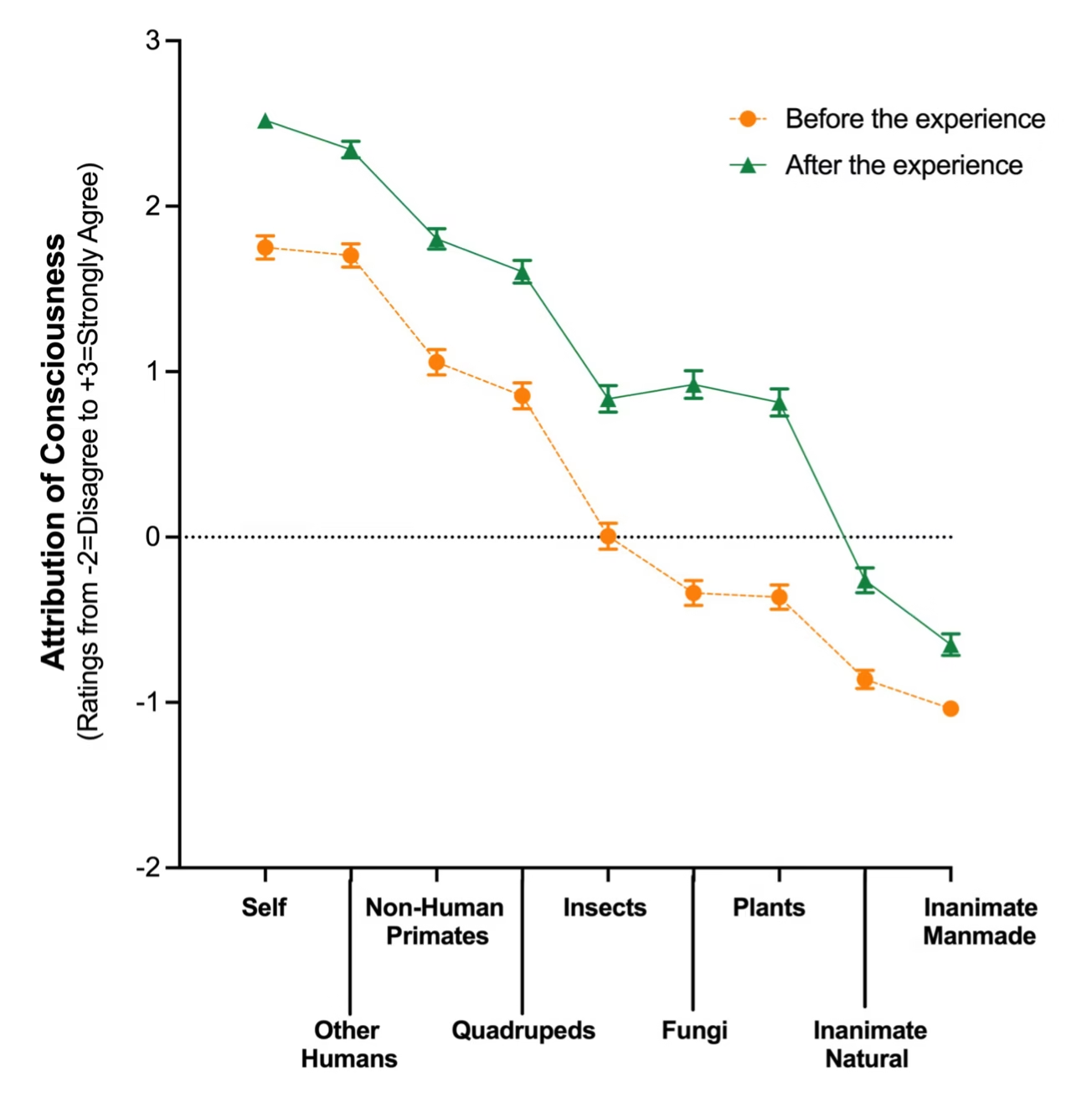
Graph of the Week
Attribution of consciousness to living and non-living entities before and after a psychedelic belief-changing experience
After psychedelic experience
Before psychedelic experience
From: A Single Belief-Changing Psychedelic Experience Is Associated With Increased Attribution of Consciousness to Living and Non-living Entities (supplementary material) by Samdeep M Nayak and Roland R. Griffiths, John Hopkins University (2022)
My bookshelf weighs a ton
Notable new purchases for the occult library. Strictly second hand snap-ups only
This week: Transcendent Mind by Imants Barrus and Julia Mossbridge. Swept on for £50 when I noticed prices were going up quickly
£52 at April 2022, £75 by early May 2022
Despite what the sort of thing I write in my day job would have you believe, government-backed public education openly invests in paranormal research (for better or worse). It even issues press releases about the positive findings. Here in the UK Northampton University is the crucible of not-so-forbidden learning, with parapsychological research taking place across several departments.
Published in 2015 by the notoriously conservative American Psychological Association Transcendent Mind contains an enthusiastic review of official investigations into consciousness, the soul, supra-physical existence and the cosmic whole.
Next issue: Ancient Greece and the Mysteries of Eueleusis
This blog is not affiliated to Vital beyond my study on the course. The content shouldn’t be taken as representative as it’s a personal reflection and includes my own lived experience of the sector too.
Psychedelic substances are prohibited in the UK, other countries and most US states. I do not condone their use nor am I evangelising for, or recommending them to you. There are more qualified people you can turn to in the Resources section but if you are considering psychedelic treatments the best person to speak to is probably your own therapist, counsellor, or doctor.
My unofficial Vital Study Zine #4 with observations from Vital Psychedelic Training and recent happenings in the space
‘Bacchus’ by Caravaggio at The Uffizi, Florence
Consciousness expansion: from cave painting, to the pyramids, and the first Psych Symposium at London’s National Gallery. How far have we got?
In week three Vital students heard from Dr Lenny Gibson, a clinical psychologist, philosopher and breathwork pioneer with ‘50 years of experience working with non-ordinary states of consciousness’ who nonetheless fitted in a storied career and founded transpersonal psychology non-profit Dreamshadow.
Gibson’s winsome and poingnant presentation elegantly examined western attitudes towards conscious thinking. His key point was that the world beyond words is no less valid – more so, even – than what we can describe. Psychedelics connect us with our intuition: as represented by the ancient gods Cerrunos and Baal, the greek god Dionysus (Bacchus to the romans) and, yes, Jesus of Arimathea who ‘turns the water into wine’. The first art, storytelling and culture derived from rites around this divine archetype.
Gibson references philosopher du jourIain McGhilchrist, and I’ll pull out this particular quote from the Matter with Things author:
“As soon as you start saying anything about this realm, you falsify it. There are certain things that simply are resistant to normal language, normal exposition. But don’t for that reason not exist.”
But he began with a comparison to the Baka tribes whose genetics diverged 70,000 years ago. They describe their ceremonial group singing as “so beautiful the self melts away” just like both psychedelics and the ‘ecstatic’ techniques the rest of us have taken just as long to work out using science instead.
In the Zine this week, arranged in the synaesthesic schema used for Vital’s curriculum:
Approach: Move any mountain with neoshamanism
Therapy: ‘Celebrating the mysteries’ is the new euphemism of choice
These five items I pulled from the week’s research are themed along Vital’s natural element-themed structure. Air provides anoverview of psychedelic use,Fireconcerns therapeutic applications,Watercovers ‘space holding’ – the art of keeping it together, Earthis where you’ll find medical matters, and Etherdiscussesintegration, the processof bringing psychedelicpower intoregularlife. Click straight through to your pet subject below.
LSD is a promethean invention that has democratised the sacrament, and given humankind the ability to heal itself says Dr Gibson
A neo shaman
The S-word, problematic from the start, is getting ever more laden.
No surprise, when you consider that the criteria for shaman-hood range, depending on your understanding, from genetic lineage, grave dedication, and fighting spirits to cure treatment resistant diseases all the way to a dubious certificate, some bongos and an Instagram account.
‘Neo shamanism’ to Gibson is humankind’s recent ability to be his own wise counsel and medicine woman. The synthesis of LSD, a colourless tasteless substance able to inspire psychedelic states in minuscule amounts, he believes has democratised the role.
Poetically, this most scientific of revelations has inspired a rebirth of personal spirituality and philosophic examination. Scholars will point out that it’s the first time in 500 years, a la Joe Tafur’s Legend of the Eagle and the Condor, that science and religion have conjoined, whether in the form of transpersonal psychologist Stanislav Grof or the discoveries of quantum physics.
“For once, and for everyone, the truth was not still a mystery. Love called to all”
Mystical healing may be associated with the Shipibo curanderos but they don’t use the word shaman themselves. In many communities associated with ‘shamanism’ the healer role itself is rare, considered apart, and special. Scientific medical training is not uncommon amongst indegeneous mystical healers.
Personally I understand exactly why usage is revered and not to be bandied about, certainly in an “I can cure you by battling with entities” manner. Gibson’s own understanding is that the neo shaman is a contemporary voyager into the new frontiers of the ‘Psyche,’ itself the name for the Greek goddess of wisdom and the soul. Obvious candidates for 20th Century LSD neo-shamanhood might be Grof, Aldous Huxley, Amanda Fielding or Jimi Hendrix. And Timothy Leary, who was scolded by RD Laing for democratising LSD… But if LSD had remained the preserve of the elite, Hendrix might never have wrote in his personal poetry after Woodstock in 1969, “For once, and for everyone, the truth was not still a mystery. Love called to all.”
Mankind’s destiny calls, and we are all ordained to answer.
The inner healer remains the preserve of the elite but its gatekeepers look ever more ridiculous
Above and below: kylix cup depicting Hades and Persephone from 430BC now in The British Museum
Accessibility is a hot topic in ‘the space’ right now. As ever.
At the inaugural Psych Symposium in London’s National Gallery earlier this May 2022, itself undeniably elitist at £400 for a basic one-day ticket and £1,000 for full access and the drinkies, MAPS spokesperson Natalie Lyla Ginsbergtold suits that “PTSD is most common in the marginalised communities who cannot currently access these treatments.” Author Zoe Cormier eviscerated corpos with lines like, “So if it’s okay for somebody dying of bowel cancer to grow their own mushrooms, why is it not okay for normal folks?” (Answer: ‘because dosages’, to a lack of any audible groans).
The Greeks famously all tripped together at the Eleusinian Mysteries, an invite-only annual bash held at the festival of Demeter for the best part of two thousand years. It’s heavily referenced in Shakespeare’s esoteric play The Tempest. Supposedly ‘The Mysteries’ was reserved only for the ‘invisible college’ wyrd and wonderful types, but high society were in on things too: “The beautiful people following the interesting people, and the rich people follow the beautiful people” as a wise lady once told me. Indeed, the use of psychedelics was only proven recently when a gruelling, decades-long investigation into the local availability of psychedelic ergot was trumped by legal records prosecuting a notorious socialite for ‘celebrating the mysteries’ at dinner parties back home in Athens (he got exiled to Sparta, by the way). Current podcast staple Brian Muraresku will tell you all about psychedelic use by the early Christians. And has been recently in great interviews like this around his book The Immortality Key.
The ancient greeks believed “Life can only be experienced in a truly terrifying, but transformational, encounter with death.”
Ritually, the Greeks supped from elaborate kylix cups (above). Medieval witches got rampant on datura, best taken internally via the mucus membrane, by inserting it vaginally – ‘riding the broomstick’. In 2022 ketamine bumps are delivered in £5,000 inhalers, and while no one is sticking DMT up their bum just yet, the common folk are hunted and persecuted by the agents of mediocrity still.
There’s a blanket thrown over the studio kitchen in the corner, a drape with some trees on and a lamp stuck behind it, plus some spiritual tat.
It does look surprisingly cosy nonetheless, especially with Dr Ros beaming angelically from her seat in the corner. But you almost certainly have to dream the Albion way to appreciate its understated succour. Bar the open heartedness oozing from the ever-radiant Dr Ros, being served the Mysteries by the priestesses of Demeter it is not. Neither is donning a blindfold plus headphones, and boasting a grin like the one that betrays the fact you don’t normally fly business class, an experience surely at all comparable to the jungle ayahuasca one.
12-step style integration and ceremony – my bad, ‘celebrating the mysteries’ – circles were mentioned as future possibilities by Psych delegates in a huddle with Imperial College trials participants Iain Roullier and Leonie Schneider, unsung heroes of the UK space who also spoke onstage with Dr Ros repping their PsyPan set-up. In the meantime there is… an app.
“The substance is only 51% of the process”
‘Holding space’ doesn’t seem to have been much of an issue during contemporary scientific tests and education regarding bad trips-stroke-challenging, purgatorial experiences may take the edge off them so to speak. Admittedly a guide, let alone a skilled psychotherapist or shaman, may be good for a bad trip too. Because surely MindMed’s ‘off switch’ jab is cheating*.
An old pal has just reminded me that our sitter was a table leg with an acid house smiley face drawn on it which we kept in the back of the van. The Wild Hunt rides.
*Take the off switch if they offer it or at least don’t say I told you not to
LSD’s versatility is wildly underestimated say thought leaders Beckley Psytech
Lady Amanda Fielding of The Beckley Foundation and now Beckley Psytech
“Microdosing is a step forward for humankind.”
Beckley Psytech’s Lady Amanda Fielding (for it is she) declared so at Psych Symposium. If psychedelics can be for the everyman, can they be for every day?
While it’s less spectacular than ‘spiritual doses’, DMT, or ayahuasca, and an ongoing science to say the least, microdosing’s arguably taken a stronger foothold in popular culture than the next-level psychedelics. Users report similar effects to integrated major experiences, like enthusiasm, geniality, consideration and walking in the woods while listening to Jon Hopkins. Famously though microdosing – which Beckley are researching throughly – is one of the few contemporary psychedelic phenomena to fail the placebo test. Small doses are being tested on some conditions: MindMed are on stage two for 20µg of LSD twice a week, while sticking someone in a room and giving them a proper tab (200µg) did okay for GAD . The likes of New Health Club are poised to bring acid to the workplace (at last). Lenny Gibson’s observation was that ‘psyche’ also means ‘breath’, and Stanislav Grof’s holotropic breathwork could be the only option – and also a better one – for many.
Professor David Nutt pointed out in his Psych presentation that it’s the ‘wellbeing’ scores that are really impressive in psychedelic therapy’s efficacy results. But according to a neuroscientist I spoke to outside when the fire alarm went off, “there are no criteria for developing drugs for ‘wellbeing’ like there might be for mental health conditions already treated pharmacologically. So everybody’s trying to make drugs, which is ruinously expensive as it is, without knowing precisely what to aim at, certainly in terms of approval.” The Mushroom Nation is at once already here, and still so far away.
NB Psychedelics are prohibited in most places even if labelled ‘cacao’ and sent in gaudy packaging. You can still get busted for them like this guy.
Is theremoreto integration thanwalkinginthewoods whilelisteningtoJohnHopkins?
‘Hyperbolic Depth’ by Wolfe Von Lenkiewicz available here
“The substance is only 51% of the treatment” said Imperial College PsiloDep 2 trial clinical lead scientist Dr Rosalind Watts at Psych Symposium 2022.
It was vehemently echoed by the PsyPan patient support group alongside her on stage at London’s National Gallery. Blasting off into hyperspace is not entirely the point either reminded week four Vital lecturer Dr Lenny Gibson, who evoked Stanislav Grof: “The ecstasy of a noumenal moment, a psychedelic intoxication, is not enough for mysticism. Such a moment comes to nothing if it does not become part of a process of lived expression and expressed thinking.”
Less than a week previously Dr Ros launched her Acer Integration project at the Earth Centre in Hackney. It’d take a heart of stone not to give the team at Acer credit and I, for one, liked the singing in the round. The mystic is sorely lacking in European research as Dr David Luke points out, and metropolitan Londoners, their dopamine receptors worn down to ichorous stubs, are polarised in their spiritual awakening or total lack thereof. I suspect it might be better for many if we stick to burning massive effigies and people just ‘get it’ on either a collective unconscious level or whatever.
Meanwhile the stock images of millennials in the blindfold and headphones are beginning to look sinister, I reckon. Once again I find myself drawn to the intriguingly complex MAPS PTSD therapy programme, where the mystical concepts so potent for healing trauma must be dealt with ever so sensitively, because the soldiers have been driven far further from God than even my neighbours in this modern-day Babylon (I like London really; non-dual thinking).
“Be kind to the guy at the grocery store. Make new friends. Put the art pedal to the floor.”
While veterans and the treatment-resistant depressed crave healing – and should go to the front of the queue – the rest of us scrabble for meaning, humanity, or merely playfulness. Nonplussed yet fascinated by doxa, Plato’s term for shallow concerns, we struggle to ‘participate in eternal totality’ as Spinoza urged. Raves, ‘sex positivity’ and Burning Man-type festivals are our attempts to break through. And ‘meaning making experiences’ may indeed prompt a breakthrough or two, but that will only be the start of a long and confusing journey for some.
Others, like us BJJ bores and Dragon’s Den/Shark Tank wannabees, ponder our lack of the right kind of trauma, that sweet spot sought by Neitzsche, Jung, and others who rarely left their desks.
The greeks did put down their books. Even Plato excelled at wrestling, competing at the Pytheon (like The Championship in English football) and Isthmian games. Both of which featured culture and sport combined incidentally. Immortality Key writer Brian Muraresku says in this great Lex Fridman interview that the greeks were also fond of saying, “Life can only be experienced in a truly terrifying, but transformational, encounter with death.” He quotes Huxley on mass radical self-transcendence and deeper understanding. Plus Alan Watts on authority being threatened by mass outbreaks of mysticism.
Myth, or ontology if you like, in the West and far beyond teaches that less thought is better than more. Lenny Gibson’s lifestyle advice: “Be kind to the guy at the grocery store. Make new friends. Put the art pedal to the floor.”