Tag: Clinical

  • Inner space of safety

    Inner space of safety

      Medical
    Medical

    MDMA boasts striking therapeutic properties beyond increased connection

        Chemical X     , ‘Spectrum’
    Chemical X , ‘Spectrum’

    “I believe MDMA is the ideal drug for psychotherapy,” says non-nonsense Awakn founder and trauma expert Dr Ben Sessa.

    The exciting bits are MDMA triggers a ‘oxytocin-dependent reopening’ of a ‘social reward learning critical period’. It puts your brain in the state of early childhood and adolescence, when it establishes key neural pathways. The hypothesis is that dysfunctional thought patterns can be adjusted in this state.

    MDMA increases pre-frontal cortex activity like an ADHD stimulant, lowers activity in the amygdala ‘fear centre’ deep in the reptile brain, and is notable for its relationship to both dopamine and serotonin. It creates an ‘optimal level of arousal’ that is neither too little nor too much for the brain to process its thoughts and instincts. 

    Added neuroplasticity helps memories reconsolidate so patients feel safer in safe settings, for example. MDMA scored strongly on PTSD patients with dissociative symptoms who often prove the toughest to treat. Trial data was consistent across the five test sites spread globally. 

    Ecstasy was first named ‘Adam’ then ‘Empathy’

    Trial subjects previously suffered severe symptoms that had resisted regular therapeutic treatment for many years.

    ‘MDMA was invented for shellshocked soldiers’ is a trope I may be guilty of falling for. It wasn’t an appetite suppressant either when patented by Merck in 1914. Forensic research into the German pharmaceutical firm suggests a humbler origins for the love drug as merely a stepping-stone towards developing an alternative to hydrastinine, used to prevent internal bleeding particularly in the uterus.

    The military nonetheless had it knocking around for whatever reason in the 1950s around the first time scientists tested MDMA on humans and recorded the results. These soon reached the keen ears of Alexander Shulgin, who says he first synthesised it in 1965. It was originally named ‘Adam’, and also ‘Empathy’. 

    Patients during MDMA-AT are given 125mg of what the subculture renamed ‘ecstasy’ with up to 75mg of booster. Apocryphally, a friend who took part in an Imperial MDMA trial said it was hella strong.

  • Psilocybin for depression with Ashleigh Murphy-Beiner

    Psilocybin for depression with Ashleigh Murphy-Beiner

    My unofficial Vital Study Zine #11 with observations from Vital Psychedelic Training and recent happenings in the space

       ‘White Light’ from      Paul Cocksedge Studio
    ‘White Light’ from Paul Cocksedge Studio

    “We have really explicit conversations about sex, about violence, about death and ego death…”

    Plus of course, “Paranoia, wanting to go to the toilet, feeling like you’re going to the toilet, and the physical bodily experiences,” says Ashley Murphy-Beiner, psychologist and guide at Imperial College’s landmark ‘PsiloDep 2’ trial, which sounds suitably like a Quatermass movie.

    Ashleigh Murphy-Beiner is exactly the sort of impressive individual driving the psychedelic renaissance: a mediation coach and Peruvian ceremony facilitator alongside her studies at Imperial College London, she’s noted for her research on ayahuasca for treating depression too. She’s talking about preparing psychedelic novices for their first trip on synthetic psilocybin, the active ingredient in old-fashioned magic mushrooms. It’s used mostly due to stigma around LSD.

    “We let them know we’re not going to judge them on anything weird… although they’re not going to do anything like that, because mainly they’re worried it’ll really embarrass them or, or cause shame,” she continues, giving a window into life with depression.

    Depression is a ‘global burden’. The main cause of disability and the number one reason for taking time off work affects a quarter of a billion people worldwide, and more in The West. One in six Brits are on anti-depressants, and US figures rose by up to 30% during the COVID-19 crisis. Doomongers will be pleased to know there are plenty more sad stats in this week’s ‘zine.

       Imperial College psychologist, meditation coach and ayahuasca advocate Asheligh Murphy-Beiner
    Imperial College psychologist, meditation coach and ayahuasca advocate Asheligh Murphy-Beiner

    Can psychedelics cure long term depression where talk therapy and medications failed? Although arguably still spectacular in comparison to existing treatment, results are frankly not as good as those for psychedelic studies on treating trauma, addiction, and end-of-life crisis. That’s partly because depression mostly remains a mystery, with the widely-accepted ‘serotonin imbalance’ theory recently publicly debunked. Ashleigh calls the causes “biopsychosocial” meaning there are biological, psychological and social implications. Many patients have come crashing down to Earth when faced with the cruel reality of life in late capitalism. Preparation and integration are absolutely essential, say trial patient advocates Ian Roullier and Leone Schneider of advocacy group PsyPAN. Dr Rosalind Watts created a treatment model, Acceptance, Connection and Embodiment to cover the ground between secular dystopian life and the psychedelic experience. 

    Results of psilocybin for depression trials so far though are certainly optimistic compared to market anti-depressants. A major advantage is that psychedelic treatment opens up the mind, rather than numbing out all feelings, like current anti-depressants are said to. Opportunity and relish can once more be a part of depressive’s mindset. Plus they can dump their daily regime of equally barely-understood serotonin pills with side-effects like a plummeting libido. 

    This is one subject for which there is certainly no silver bullet. Here’s Ashleigh talking about ayahuasca, and the ACE therapy model used at the trials with Dr Ros, plus the ethics of the trials and therapy itself, and rounding up the trial results on the Chasing Consciousness podcast, all of which you can see on the New Psychonaut YouTube channel.

    This week’s topics arranged along Vital’s core learning pillars are below.

    Next issue: MAPS MDMA-AT program designers Michael and Annie Mithoefer.

  • Freud is dead

    Freud is dead

      Therapy
    Therapy

    ‘ACE’ is a new therapeutic approach devised by Drs Ros and Richards, with inspo from Stan Grof

       ‘Icosahedron’ by Anthony James from      Unit London
    ‘Icosahedron’ by Anthony James from Unit London

    Freud is Dead. And we have killed him.

    My loose understanding of the gossip in the ivory towers of psychology is that Freudian psychoanalysis maintains an iron grip on legitimacy. 

    This seems to have crumbled almost overnight like empires do. Psychoanalysis’ spiritual home The Tavistock Clinic has been rocked by scandal. And Imperial College didn’t use psychoanalysis as such in PsiloDep 2. Because it’s only been an initial part of psychedelic therapy as documented by Stanislav Grof. 

    Indeed Grof’s former colleague, TV’s Dr Bill Richards who’s still kicking it himself at John Hopkins (and on Netflix) advised on Acceptance, Connection and Embodiment (ACE) therapy, the model applied by Imperial College in its landmark trials testing psilocybin against a market SSRI anti-depressant.

    “The trials followed a standard psychedelic psychedelic therapy format: preparation, the high dose, and then integration alongside an Acceptance and Commitment Therapy [ACT] adapted model,” relays Ashleigh. 

    ACT is a kind-of proactive mindfulness to encourage ‘psychological flexibility’ an adaptive mindset resilient to stressful events. The psychological flexibility model or PFM is referred to in the title of Dr Ros’ stealth bomber of a paper, The use of the psychological flexibility model to support psychedelic assisted therapy which points out the approach is in use in trials at NYU and Yale, too.

    And guess what? Everyone prefers it to being told stuff in the past they were doing their best to forget has ruined both their present and future, so it’s going to cost them £200 a week. Plus, ACT’s explanatory infographic is a freaking icosahedron, the sacred geometric form that’s like a 20-sided Dungeons & Dragons dice.

       Acceptance and commitment therapy’s ‘hexaflex’ graph
    Acceptance and commitment therapy’s ‘hexaflex’ graph

    ACT is empirically proven in all of these tests we’re beginning to think will be endless, and approved by EG the NHS.

    “It’s a very complex experience that people are going through. So we’re using lots of different influences”

    But because ACT’s not Freudian analysis, it gets crap from the old guard. Seems like nobody cares what they think any more, though, because their way hasn’t worked, except for them. And they gave kids gender reassignment.

    That’s not all. “As clinicians, we were drawing on a lot of different psychological theories to support people because it’s a very complex experience that people are going through. So we’re using lots of different influences,” says Ashleigh.

    ACE is Dr Rosalind ‘Ros’ Watts’ remix of ACT. It even has P-ACE (for preparation) and I-ACE (for integration). It includes aspects of polyvagal theory, lived experience and non-dual thinking to name but two.

    And there’s even deferral to the inner healer or ‘homeostatic instinct’ to give it its new scientific name in ACE. Metaphors employed for the healing process include ‘diving for pearls’ illustrated by specially prepared visualisers. Plus, let’s not forget, a new ambient John Hopkins’ LP bespoke-made for the trials.

    “We’re asking people to open up to emotional pain at a pace they may never have experienced”

    Stan Grof says psychoanalysis was useful for the earliest stages of treating in-patients, but soon gave way to even more fundamental realms of the psyche – and body – that required knowledge not only of cutting-edge thinkers.

    “I wonder how possible it is to grasp”

    He names William Reich for perinatal matrix III when the body spasms start (not seen many of those on the course yet) and Jung in his Red Book days, but the ‘transpersonal’ (IE weird), plus theology, literature and philosophy too.

    “We invite them to tap into a sense that there may be wisdom and guidance to be learned from emotional pain, and difficult experiences in life,” says Ashleigh. There’s practical considerations that don’t come up in that room your therapist has in Finsbury Park with the knitted throws and knackered dreamcatcher on the ceiling.

    “We’re asking people to open up to emotional pain, to an extent, and at a pace they may never have experienced before,” says Ashleigh, “I wonder how possible it is to grasp. We wrangled over what we tell people beforehand, so they can make an ethical and informed decision about taking part in a treatment like this.”

    ‘Must we ourselves become gods simply to appear worthy of it?’ opined Nietzsche upon his most famous line, ‘God is dead.’ The firebrand philosopher meant a sense of shared, guiding ideology rather than the monotheistic biblical concept of God.

    He was mostly right, because us stupid normies did come up with a new God – science. The bits of that which considered our relationships to each other, so the only ones that counted, originated from Sigmund Freud, and Richard Dawkins via Charles Darwin.

    The new anti-religion preached a mirror image of historical spirituality: humans were essentially chimpanzees, except cleverer, so even more unpleasant to each other.

    Arts, achievement, compassion, shared laughter… all just tactics in the game to get ahead. Beneath it all we were just throwing our turds at each other, and pretending not to enjoy getting screwed by the alpha male.

    Who hasn’t been seduced by this perverse science at some point? Especially on cocaine, like Sigmund Freud was half the time. 

    Eventually though it gets… depressing.
  • A Love Unconditional

    A Love Unconditional

      Space
    Space

    Wanted: open hearts to hold space over borderline personality disorder

       From ‘     Dappled Light     ’ by Rana Begum showing till September 2022 at Ptizhanger Manor and Gallery
    From ‘ Dappled Light ’ by Rana Begum showing till September 2022 at Ptizhanger Manor and Gallery

    If there’s a subject in mental health that’s lively as psychedelics, it’s borderline personality disorder or BPD. Things got even stormier when the two got together. 

    Or rather, didn’t. Psychedelic hierophant, Imperial College’s Dr Robin Carharrt Harris ruled personality disorder sufferers out of psilocybin trials in the earliest stages of reporting. Interpersonal relationship issues might prevent these voyagers achieving a necessarily productive therapeutic relationship with their guides, hindering ‘letting go’ to the experience. 

    Asked about respite for personality disorder sufferers in the Vital Q&A about her work at Imperial College with psilocybin, Ashleigh declares she certainly hopes so. She highlights a courageous academic appeal by Toronto’s Rick Zeifman, and Anne Wagner of the city’s Remedy clinic, on the subject.

    The paper notes how clinically-proven effects of psychedelics, like increased mindfulness, a clearer sense of identity and behaviour, healing addictions and a reduction in suicidal tendencies line up neatly with BPD’s issues. The impressive doc proposes possible treatment angles including dialectal behaviour therapy (DBT) a socratic method invented for BPD, plus transference-based therapy (big up the space holders there). It also cites a bunch of examples where BPD symptoms were markedly improved by psychedelic treatment: MDMA looks like the front-runner for medical modality, but Swiss researchers say many came to them seeking LSD treatment for narcissistic personality disorder (NPD) in the late 80s and 90s with no major reported issues. Say what you like about them, but anyone turning up for LSD therapy saying “I’m a massive abusive narcissist, please help me” has done their shadow work. Moreover, just recently doctors in Basel claimed success when treating a complex personality disorder with LSD and MDMA. “This decision was not taken lightly,” reads the abstract.

    There’s currently no medication for BPD but sufferers can be prescribed for co-morbidities. Savage psychological wounds, acute trauma, prompt intense abandonment fear in BPD sufferers, possibly leading to volatile and self-sabotaging behaviour. In a thoughtful article on BPD from multiple award-winning UK Cosmopolitan mag, expert Dr Dawn Starley levels it all out by reminding smartphone shrinks that by no means all personality disorder sufferers are disruptive. Moreover, any perceived cruelty, mind games or violence come from a place of terror rather than sadism. Words like ‘guilty’ and ‘innocent’ are perhaps not nuanced enough (sync!) to describe a BPD court defendant (certainly a diagnosed one). And neither is, for example, ‘manipulation’, says BPD specialist Dr Susan Heitler.

    Equally, “[Partners, friends and family members] can experience feeling abused or gaslighted themselves. The negative experience for some is substantial,” she says. It’s natural to want to help a loved one in trouble. Selfishly wishing your lover would just get better is forgivable too. But the two of you are often better served by staying apart. This is non-dual acceptance at its starkest.

  • IRL is a bummer

    IRL is a bummer

      In  te  gr  at  io  n
    In te gr at io n

    Returning to everyday existence brings depression patients right back down

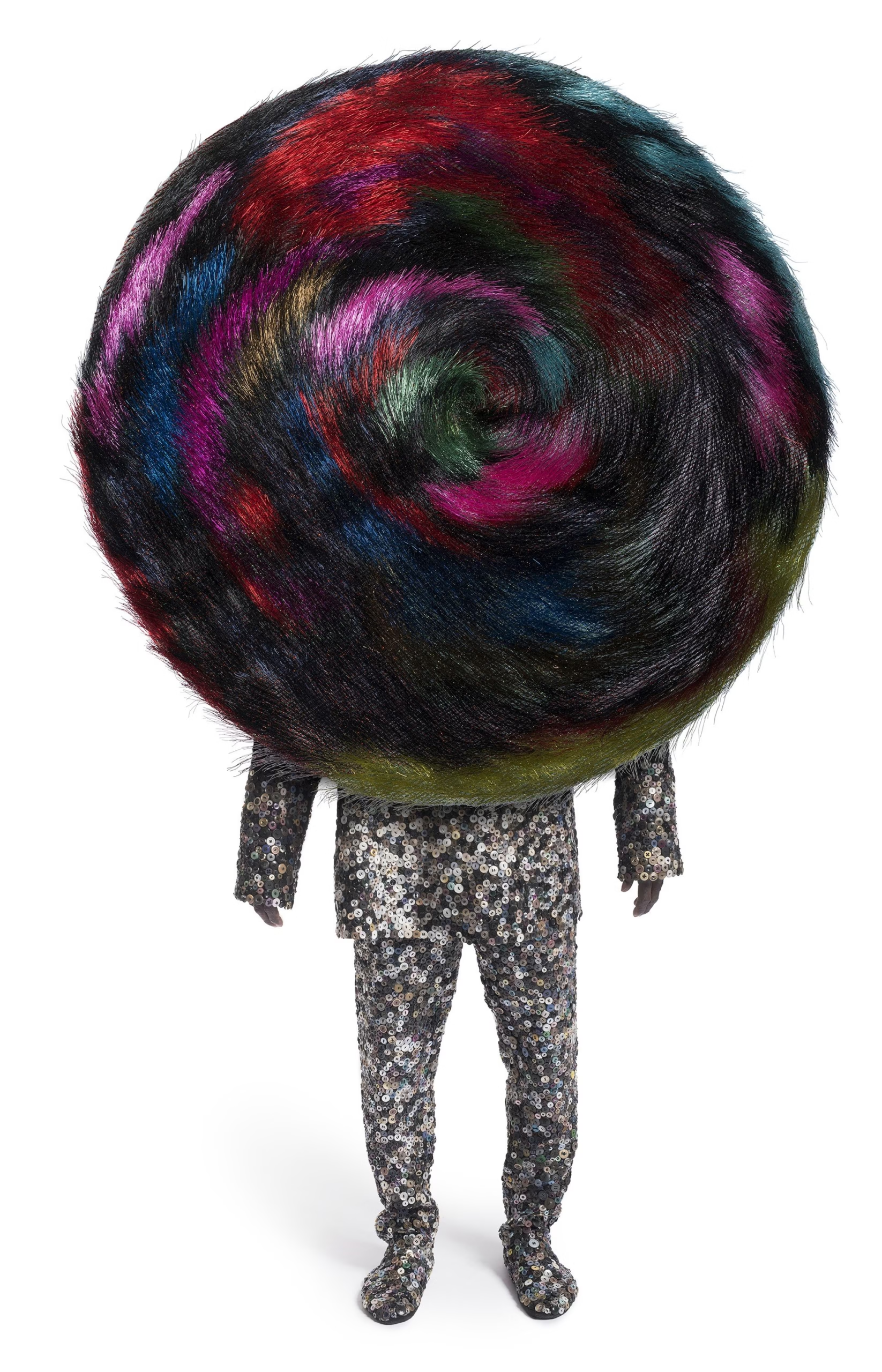
       Nick Cave ‘Soundsuit’ at      In the Black Fantastic      Hayward Gallery till  September 18
    Nick Cave ‘Soundsuit’ at In the Black Fantastic Hayward Gallery till September 18

    Psychedelic integration isn’t the ideal topic for water cooler chat with your line manager on a Monday morning.

    Meditation, vegetarian diets, forest bathing and volunteering, all inspired by the cosmic visions on a magic mushroom trip. It all sounds suspiciously like hippy stuff, guaranteed to create even more disconnect between you, your news cycle-bedevilled colleagues, wine-guzzling borderline alcoholic partner, and rigid family. 

    “Most of the people I’ve worked with have had a disappointing crash. Integration is partly about managing that disappointment. You can’t separate the drug from the therapy – and the community you go back to after a session,” said Dr Ros, AKA PsiloDep 2 clinical lead Dr Rosalind Watts at Psych Symposium’s integration panel earlier this year also featuring Ian Roullier, co-founder of trial subject support and campaigning group PsyPAN

    “My colleagues think it’s extreme… whacky”

    PsiloDep 2 trial subjects were given 35 to 40 hours of therapy, which is more than I’ve had in my life. But costs, for a start, kept post-experience integration services light. The trial subjects’ woe prompted Dr Ros to manifest ACER, her integration platform that “involves getting into nature and a closely bonded support group, that’s saved all of us during the pandemic,” says Roullier. 

    Former international-level professional sportsman and Iboga advocate Rory Lamont was on the panel too. played rugby, a traditional contact sport that’s notorious for its conservative values. He only had the informal WhatsApp group set up by the folks on his retreat for succour. 

    “I went through some difficult challenges post experience,” he told the panel, “The connection with the medicine is just the start: we want to embody the insights but if we’re not being met by our family and friends it’s isolating and can bring back the loneliness, and the depression.”

    The new approaches his insights compelled him to take were nightmarishly distant from his existing lifestyle. “These medicines get to the root of our suffering, the trauma and disconnection from family, friends, society,” he says, “Instead we get a connection to mother nature and community, that brings about the profound healing.” After the experience is over though it’s straight back to ‘real life’, such as it is. Most of my colleagues think it’s extreme, whacky,” says Lamont.

    “The worst part is when you feel the effect fading, and you can’t access it any more”

    PsyPAN co-founder Leonie Schneider says psilocybin was “the start of a long healing process which I’m very grateful for, but it’s quite a thing to be involved in. I didn’t get the ego death, the mystical experience, and came out slightly disappointed. But I got some other, incredible things that we wren’t what I expected.” Schneider may not have been able to get those benefits without experienced integration support. 

    Ian Roulllier also took part in Compass’ psilocybin trials, where “my depression came back as soon as the drug wore off. But there was a strong focus on integration with a group centred on Maudsley Hospital [where Compass and the UK NHS public healthcare provider are building a dedicated centre in woodlands of New Bethlehem AKA ‘Bedlam’ asylum].” 

    The drugs are catalysts and require the integration to have long-term tangible effects, says Roullier. Trial subjects can’t breeze into Imperial for another heroic dose top-up, “The worst part is when you feel the effect fading, and you can’t access it any more.” 

    Although there were moments of oceanic boundlessness. 

    “The best is every now and then I check in, and just go out on the grass, and feel it under my feet,” muses Roullier, movingly and sincerely, “But I did get attacked by a swarm of wasps once. I thought, am I still tripping?”

  • The Ethics of Caring in Psychedelic Therapy with Kylea Taylor

    The Ethics of Caring in Psychedelic Therapy with Kylea Taylor

    My unofficial Vital Study Zine #10 with observations from Vital Psychedelic Training and recent happenings in the space

       From Phantom VII by      Neil Krug
    From Phantom VII by Neil Krug

    “We don’t rush to sign up for ethics classes,” says Kylea Taylor, a storied therapist who’s become the conscience of the psychedelic renaissance.

    But you’d be surprised, she says: “All our great tales and stories are concerned with dilemma, redemption and ethical themes. The field can be surprisingly interesting and worthwhile, plus you learn a lot about yourself.”

    ‘Ethics is the study of relationship’ says Taylor’s website for her InnerEthics program detailed in her respected book The Ethics of Caring. If we are defined by our interactions, then ethics are a crucial part of our existence. Taylor, I’ll point out, is no out of touch pharisee. Graduating in marriage and family therapy in the late 1960s, she worked as an addiction specialist throughout the 1970s including nine years in a residential rehab. She’s been with the Grof Foundation since the 1990s having trained there since 1984 (she calls them “Stan and Christina” at one point which is way cool).

    “Self-compassion and self-work are absolutely key”

    These days it’s not only addiction counsellors and psychedelic pioneers who sometimes deal with tricky individuals. Not for nothing are self-books with titles like The Five Types of People Who Will Ruin Your Life all the rage. It turns out that ‘drawing boundaries’ which we’ve all been told is the secret to negotiating life by our (childless, spouseless, mostly jobless) therapists, doesn’t actually work against bastards. Or if not bastards then the folk who’ve worked out they can make their ethics up as they go along, mostly – in a world where God is dead and Alfred North Whitehead is yet to be a household name. 

    “Ethical relationships are the relationships that are healing”

    Taylor tells of an acquaintance, a qualified and licensed female therapist, who dabbled with holotropic breath work and shagged a long-term male client who she’d had an intense session with. He sued her and she lost everything. “Why did this happen to a good, well-intentioned, well-trained therapist?” says Taylor, “because we need to discover as much as we can about our motivations, be completely sensitive to client safety, and educate ourselves about extraordinary states.”

    It’s not difficult to accept that psychedelic drug use and exotic religious ceremonies might get a bit sketchy sometimes. Denizens of the underground learn to pick their way around the gloom; some though trip over, into the murk. Go down into the Power Trip podcast rabbit hole for New York Magazine’s exposé series covering both the nascent scene and recent trials at MAPS, where perfection is absent even in the most optimistic of scenarios. 

    “If clients feel trust they’ll be more willing to go into strange spaces”

    Because we are human, reminds Taylor. She’s trained with Stanislav Grof’s Foundation since 1984. He wrote in LSD Therapy that we should strive to be more than human nonetheless, and Taylor thinks so too. 

    “Self-compassion and self-work are absolutely key,” says Taylor, who advised on MAPS’ new Code of Ethics. Current ethical codes don’t examine therapist motivations, and certainly not higher states of consciousness. While we must grill ourselves on our own weaknesses, we mustn’t overly admonish ourselves for mistakes in a new, difficult arena. 

    “We turn up the volume in psychedelic therapy. All internal and relational dynamics present have more impact for the client. Thoughts, words, feelings and intuitions affect the client and the therapist, much more than in a regular therapy session,” warns Taylor. Kundalini is one of her fields and she advises to look out for spiritual emergencies of both the dramatic and everyday kind: “realisation of cognitive dissonance can be a huge shock for many.”

    Self-work leads to self-realisation, self-compassion, stronger boundaries, and a finer relationship with others. It makes a psychedelic therapist better at their job.

    “Ethical relationships are the relationships that are healing. If clients feel trust they’ll be more willing to go into strange spaces and approach difficult feelings,” says Taylor.

    Here’s what else I flagged up, colour-coded to Vital’s themes of Approach, Therapy, Space Holding, Medical and Integration.

  • Power to Empower

    Power to Empower

      Approach
    Approach

    Inner journeys require deft guidance deployed with subtlety

       From Seascapes by Paul Rosteau published by      Loose Joints
    From Seascapes by Paul Rosteau published by Loose Joints

    Talismanic underground figure Leo ‘The Secret Chief’ Zef began his psychedelic guide self-training using talk therapy in his voyagers’ sessions.

    Eventually he wrote, “I realised I didn’t know what they needed and neither did they. Something inside them did. Just leave ‘em alone!”

    Photos of the general public tripping in blindfold-and-headphones under strip lighting prompts revulsion in recreational users – or it did in myself, certainly.

    Stanislav Grof, ‘The godfather of LSD’ according to its inventor Albert Hoffman, who ‘nobody has contributed as much to the development of my problem child’ explains in his landmark work LSD Therapy that he went through a similar thought process as a researcher in the 1960s and 70s. 

    The simultaneous model,‘psycholytic therapy’ Grof says does have its advantages compared to regular psychoanalysis, cutting treatment times by a third. But the doses he believes are too regular and possibly too small. Most importantly, the open-ended process has no focus on the rigorous analysis and integration of insights. 

    “It will seem weird to them. Normalise. Don’t pathologise”

    Grof concluded that ‘psychedelic therapy’ which features three to four regular therapy sessions punctuated by high dose experiences where the patient mostly corresponds with their inner healer, 

    While skilful guidance by the therapists can make impact, this requires elegance and subtlety. 

    Vital Week Ten lecturer Kylea Taylor has worked for Grof Transpersonal Training since the 1990s. Like veteran Dr Bill Richards back in Week Four, she says the number one thing to keep in mind is the existence, and the potency, of the inner healer. In an ethical context this means trusting the client’s relationship with the process more than yourself. 

    “Work at the speed of safety. Move at the speed of trust”

    Creating a sense of permission to unfold, “the power to empower” is a very different role to that of the modern psychotherapist, who in my own experience prefers their narrative to any individual ones. Let alone any insight dispensed by cosmic visions.

    “Normalise, don’t pathologise,” says Taylor, “It will seem weird to them, outside their own frame of reference.” While I absolutely agree this will be true for some voyagers, I’m inclined to believe plenty of others will find their fantastical visions more compelling than a grim raking over of their early childhood, accompanied by a gentle shaming of any non-narrative impulses. Get out the Soul Collage, which is like a ‘make your own Red Book kit’.

    “Think, ‘How can I support this client to take their next step into freedom, where they can be fully who they are?’” Says Taylor, again echoing Bill Richards who worked alongside Grof for many years, this time with his ‘cosmic midwife’ allusion. Providing examples, stories and suggested reading are more appropriate than Freudian psychoanalysis, which can seem terribly pompous when you’re tripping. Just like all cokeheads. Stop gabbling like one right now: “Part of good attunement is not knowing what’s going on with them and attuning nonetheless,” says Taylor. 

    And don’t rush it, despite the promises of miracle cures. “Work at the speed of safety… move at the speed of trust. Especially with clients who have a different life experience.”

  • Who’s therapy is it anyway?

    Who’s therapy is it anyway?

      Therapy
    Therapy

    Probe your own intentions, for the floor of the abyss is littered with wounded healers

       From Phantom VII by      Neil Krug
    From Phantom VII by Neil Krug

    The will to power exists even in the most open hearts: “Every ethical misstep has a healing impulse,” says therapist ethics expert Kylea Taylor.

    73.9% of therapeutic professionals entered the field due to their personal history. The ‘wounded healer concept was flagged by Carl Jung, who wrote “A good half of every treatment that probes at all deeply consists in the doctor’s examining himself… it is his own hurt that gives a measure of his power to heal.”

    A psychedelic guide must wrangle with their reasons for being in the space. Achievement, hoping the voyager enjoys a significant experience, is a forgivable impulse; influence too if we’re being as honest like both the medicine, and the guide’s role, demand.

    “Mistakes are an opportunity for improvement and change”

    But the guide isn’t drilling the patient like a sports coach. Complementing the voyager’s experience is akin to dancing with them, says Taylor in the deft analogy she uses in her book The Ethics of Caring.

    “We do best in the dance when we are not ahead of ourselves,” she explains of letting the process and the client lead this technicolour two-step, “we are able to know what we need to know in the moment.” One must be instinctively aware of one’s dance partner, the music and the dance floor. “A foot in the client’s world and the other in our role of providing safety,” illustrates Taylor, “The container is the ballroom; others are dancing there too… it’s set and setting, preparation, relationship, and relational dynamics – and the psychedelic space itself.”

    The effortless presence of mind honed in meditation is considered the number one skill required for psychedelic therapists, claims Taylor’s presentation, and she is consulting for two different written codes of ethics currently in development. Taylor calls this ‘bi-modal’ consciousness. To me it seems quite demanding; out of reach of many perhaps. “Unawareness leads to missteps and sore toes,” says Taylor, “but mistakes are an opportunity for improvement and change.”

  • Nothing beats lived experience

    Nothing beats lived experience

      Space
    Space

    Only by learning on the job can guides figure out how to deliver ethical psychedelic therapy

       From ས་གཞི་སྔོན་པོ་འགྱུར། (The Earth Turned Green) by Shen Xin at the      Swiss Institute in New York until August 28
    From ས་གཞི་སྔོན་པོ་འགྱུར། (The Earth Turned Green) by Shen Xin at the Swiss Institute in New York until August 28

    There’s no substitute for first-hand learning with psychedelic therapy says its number one ethics coach Kylea Taylor.

    Like sparring in combat sports, you can hit as many punchbags as you like but nothing beats the real thing.

    “Transference and intensity are triggers. What we’re trying to use emotionally, and what we connect to, can stir up our own sensations,” says Taylor.

    Only the act itself can provide the level of intensity and pressure to identify the areas where we need to improve, and do better. Yes, that’s Maria Sabina’s lilt you can hear fading into the background music to this article, as we ponder for a moment how psychedelic therapy evokes the indigenous lifestyle where there is no school and the only knowledge is directly acquired.

    Back to minding your Ps and Qs at the ketamine clinic. “We will get even more familiar with our own unknown material,” says Taylor of the necessity to walk the walk.

    “Be conscious of feelings in your body, energy… an opening of the trauma capsule within you”

    Because noticing when you’re off on your hamster wheel is hard. “We can’t focus back on the plan cos we don’ even know that we aren’t focussed on the plan,” says Taylor.

    To give one example, in complex post-traumatic stress disorder blockbuster From Surviving to Thriving Pete Walker describes the inner critic as ‘sneaky’. Just when you think you’ve got tabs on it, the utter bastard finds a way to express itself that even one’s Vital-trained, shadow-integrated self doesn’t put into the ‘twattish behaviour’ category – yet. Other ingrained patterns can be equally polymorphous. 

    “Trigger management is the most noticeable area of sitting,” says Taylor who first began working with the Grof Foundation in 1984, “When we are sitting in a psychedelic session we are much more likely to have deep brain responses than in a regular talk therapy session. The older parts of our brain react much faster. If we are deeply triggered the reptile brain won’t consult the neocortex for what we learned in the ethics class.” For example: the amygdala fear response deep inside the oldest part of the human brain still has complete control over the senses of touch, smell and taste, only deigning to consult the past 200 million years of evolution on sights and sounds. 

    “The more self work you do, the more you’ll recognise… and extend self-compassion”

    Stanislav Grof calls our internal mini-narratives ‘systems of condensed experience’ or COEX. “We must choose to come out of the COEX capsule and refocus on the client,” says Taylor, using the phrase “in process” to describe a therapist essentially acting out with the best of intentions.

    Compulsive behaviour of all levels is notoriously gruelling to identify and heal. Lack of awareness is intrinsic, and complete: like a dream, anger, or a PTSD flashback. So is humanity under pressure – the compulsion to succeed with a patient who reminds the therapist of the son they ‘failed’ to ‘save’, or the instinct to share a positive ideology.

    “Try to be conscious of feelings in your body, an energy; the opening of the trauma capsule within you,” says Taylor. As ever, “The more self work you do, the more you’ll recognise… and extend self-compassion.”

  • Unconditionally loving cuddles: Yes or No?

    Unconditionally loving cuddles: Yes or No?

      Medical
    Medical

    What if the patient would benefit from a clasp of the shoulder or supportive hug? Easy tiger…

        Ravers in east London
    Ravers in east London

    Don’t put it past anyone’s shadow self not to get off with a pilled-up patient.

    That’s the message from therapy ethics expert, transpersonal psychologist and addiction counsellor Kylea Taylor.

    I’d hate to wipe any glamorous, lifestyle magazine-sheen from the Vital Student Zine. Yet seeing as this is ‘The Ethics Issue’ of Unofficial Vital Student ‘Zine it’d be remiss of me not to mention the sordid revelations to have swept the psychedelic space of late. 

    First fell Francoise Borat, the French figure fancied by many more than myself. Women like Maria Papasyrou, Adele LaFrance, Celia Morgan and Reanne Crane are tackling the least agreeable and most necessary areas of the psychedelic renaissance right now, and Borat pioneered that. Investigations showed she lived up to her femme fatale archetype.

    The scandal also exposed the wellbeing industry’s appalling lack of oversight, from passing your email address on to cat charities to… not actually removing famous people from your public register after you’d struck them from the official register for shagging clients. The stink was mostly coming from Bourzat’s hubby Aharon Grossbard in the form of detailed and sustained allegations by counsellor, campaigner and award-winning blogger Will Hall.

    “Have a safe word. Even if it’s just: Stop”

    Next, just when you were thinking some boomers may be OK, MAPS therapist dyad Richard Yensen and Donna Dryer blotted the saintly org’s copybook during landmark 2015 trails. It’s worth watching the CCTV. Trial subject Meaghan Buisson, a PTSD sufferer who took the edge off her condition with a career in the tough sport of inline speed skating, then moved near the couple as her only option to continue treatment. Yensen and her slept together during the period.

    In 2022, welcome to a world of headlines like A psychedelic therapist allegedly took millions from a Holocaust survivor, highlighting worries about elders taking hallucinogens. Campaigning website Psymposia which produced the Power Trip podcast with New York Magazine that brought many of these stories to a wider audience, does a sterling if militant job of sniffing out stuff like this.

    Thing is, some patients really would like a hug during MDMA therapy. Recreational users might sympathise. Written and thoroughly discussed pre-agreements are the done thing, says Taylor. 

    “Have the safe word, even if it’s just ‘stop’, and tell the patient, ‘Remember you can say stop’ even when you’re merely putting a blanket over them,” advises Taylor, “a lot of people are recommending a dual consent process involving a written agreement on touch, that is sacred and not changed in the middle of the session.” 

    The subject should be fully felt through: “Explain the reasons why they might want it, and might not want it, and that if they say no now, they won’t get touched in the session,” says Taylor. California bioenergetics bodywork teachers have legal license to handle clients when required. 

    Strictly unconditionally loving cuddles can be a productive part of emotional breakthrough, release and recovery, say many therapists.

    “A third agreement is ‘If you do ask me to touch you in the session, I will’,” suggests Taylor, “If they do want that, then watch out for obvious gestures suggesting they might require physical comforting. If their body language suggests it, then you might – for example – touch the back of their hand, and read their reaction.”

    It’s a jungle out there and not all accusations, unfortunately, carry complete legitimacy. Professionals in an area as unpredictable as psychology, let alone shamanism, expect accusation of some sort eventually according to Vital students in the field. Soccer players in the UK are advised to simply stay away from any form of ‘nightlife’ as it’s known in sporting circles, and most now do.